
Al-Lat and Al-Uzza: The Goddesses Arabia Worshipped Before Islam

Quick Answer
Al-Lat of Taif and Al-Uzza of Nakhla were the most famous idols of pre-Islamic Arabia - named in the Quran (53:19-20), crowned with the crescent moon, served by priests in star-aligned temples, and carried in the names of Mecca's nobility. This article traces them through the Book of Idols, tells how Khalid ibn al-Walid destroyed Al-Uzza's shrine, and closes the episode with Hudhaifa's principle: ask about evil to avoid it.
Three Names in the Quran
The Quran names them directly, in a passage that still challenges every reader: 'So have you considered al-Lat and al-Uzza? And Manat, the third - the other one?' (Surah An-Najm 53:19-20, Saheeh International). These were the three most famous idols of Arabia, and the Quran places them in a passage dismantling the idolaters' claim that their gods could intercede for them. They were not minor village shrines. Al-Lat was the goddess of Taif, Al-Uzza was called the greatest of the three, and their worship stretched from Yemen to Syria. This article tells their story as our end-times episode presents it: from the Quran's naming, through the Book of Idols, to their destruction - and the prophecy that names them again.
Manat, the Third of the Three
The verse names a third: 'and Manat, the third - the other one.' Manat was the goddess of fate and death, and her shrine stood at Qudayd, on the road between Mecca and Medina, where pilgrims would shave their heads in her honor. She completes the trio the Quran confronted: Al-Lat of Taif, Al-Uzza of Nakhla, and Manat of the pilgrim road. Our episode gives her less space than the other two, but the Quran gives her equal billing, and the point stands for all three: these were not folk superstitions of the margins but the established religion of Arabia's cities, roads, and tribes. When the verse asked, 'Have you considered them?' it was asking about gods whose names were on the lips of nobles, whose shrines dotted the trade routes, and whose priests claimed to speak for heaven itself.
Al-Lat, the Goddess of Taif
Al-Lat was the idol of the city of Taif, worshipped mainly by the tribe of Thaqif. The word Lat comes from ilaha, meaning goddess - the feminine form of the word for a god. Some derive it from al-Latta, a woman who used to mix flour with ghee and feed the pilgrims; the idol, they say, was set up on the grave of that woman. Whether the name came from grammar or from a generous woman of Taif, the result was the same: a goddess enthroned over one of Arabia's proudest cities, served by one of its strongest tribes. When the Quran asked, 'Have you seen Al-Lat?' every listener in Arabia knew exactly who was meant.
A Goddess Beyond Arabia
The worship of Al-Lat did not stop at the borders of Arabia. The Greek historian Herodotus mentions a goddess called Alilat, whose worship extended from Greece to Iraq - the episode's research presents this as evidence of how far back her name reaches. In Palmyra, in Syria, a stone was once found on which someone had sworn by the name of Al-Lat, and the statues of Al-Lat found at Palmyra are shaped as an Arabian woman: a crescent-moon crown on her head and a lion's image in her hand. She was depicted seated on a lion, crowned with the crescent, and the whole figure was tied to the worship of the heavens - a moon goddess for a people who navigated by the stars.
Temples Aligned With the Stars
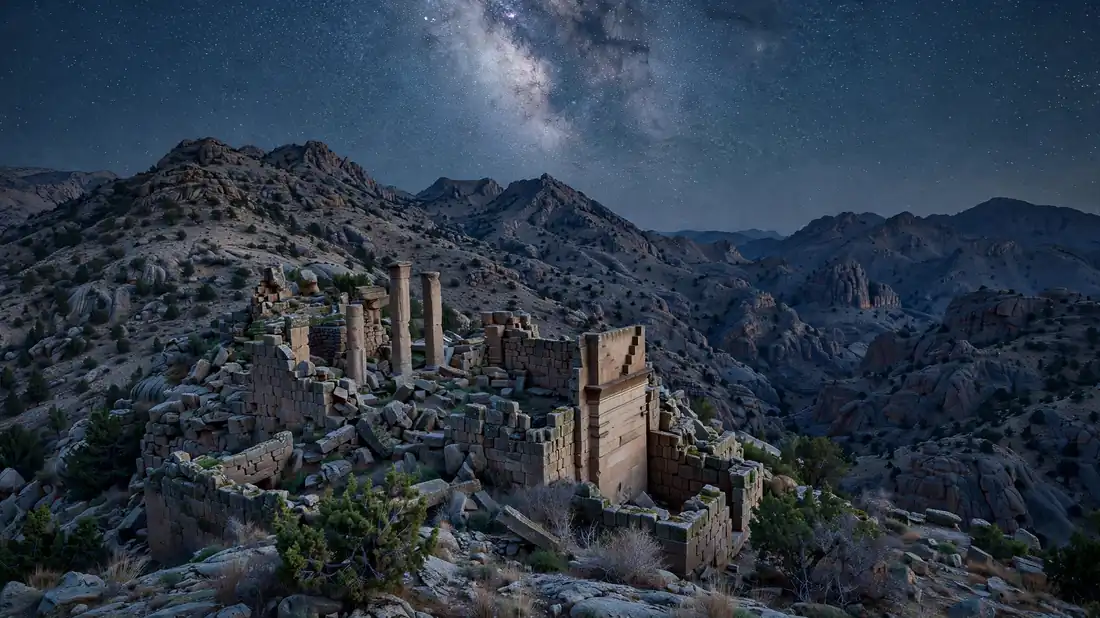
The spread of her worship was enormous: Taif, Wadi Hijr, Palmyra, Hurran, Jordan, and places in Yemen - the same mountainous Yemeni regions where ancient star-worshippers had built their temples. And archaeology, as the episode notes, confirms the pattern: the temples attributed to Al-Lat were aligned with the stars. This detail matters because it shows what kind of religion this was. It was not only the worship of a stone in Taif; it was part of a whole sky-religion, with temples oriented to the heavens and a goddess crowned with the moon. When Islam came, it did not only smash idols - it turned a whole civilization's eyes away from the worship of the sky.
Al-Uzza, the Greatest
Of the three, Al-Uzza was called the greatest. Her name comes from al-Izzah - might, honor, glory - in the feminine form: the goddess of power. She had a valley dedicated to her: Wadi Nakhla, also called Hurad. Her sanctuary stood there, and her worshippers believed she could speak - that she communicated with her priests, who relayed her words to the people. A goddess of power, with her own valley, her own priests, and a voice that her followers claimed to hear: this was the most formidable idol in Arabia. The Quraysh of Mecca themselves took her name into their own households, which shows how completely her worship had captured the most powerful tribe of the Hijaz.
The Slave of Al-Uzza
Her status was so high that the Quraysh named their children after her. The most famous example is also the most ironic: Abu Lahab, the Prophet's fiercest enemy, whose real name was Abdul Uzza - the slave of Al-Uzza. A man remembered in the Quran for his opposition to Islam carried in his own name the mark of the goddess his people worshipped. The name shows how deeply her worship ran in Mecca. She was not a distant goddess of the desert; she was in the names of the nobility, in the valley of Nakhla a day's journey from Mecca, in the daily religion of the city that would become the center of Islam. To defeat Al-Uzza was to defeat the religion of Mecca itself.
Khalid ibn al-Walid's Mission
The destruction of Al-Uzza was entrusted to Khalid ibn al-Walid. He went to the valley of Nakhla and cut down the trees around the sanctuary, destroying what he found. He returned to the Prophet - who told him: you have done nothing yet. The real Al-Uzza is still there. Khalid went back. This time he found another path leading inside the hill, and entering the passage he saw a large statue of Al-Uzza. Suddenly the high priest appeared, shouting, calling on Al-Uzza to disfigure Khalid and inflict madness on him. Then, from behind the statue, a strange and frightening woman emerged: naked, her hair disheveled, throwing dust on her head. Khalid attacked and finished her. As he struck, he addressed her: 'Uzza, you are not worthy of respect but of rejection; I have seen that Allah has humiliated you.' When he reported everything to the Prophet, the answer came: yes, that was Al-Uzza.

Weighing the Report Honestly
We report the sources of this account exactly as the episode gives them, and we guess nothing. The episode cites the story from al-Haythami's Majma al-Zawaid, without giving a hadith number; the extra detail of Khalid's words comes, it says, from Ibn Abi Shaybah. The substance of the report - a dark, unkempt woman who was not a human being but a female devil, destroyed by Khalid - is also recorded by other early historians such as al-Waqidi, Ibn Sa'd, al-Tabarani, al-Bayhaqi, and Abu Ya'la, as one classical fatwa collection notes. The Kitab al-Asnam gives a deeper version still, through a narration of Abdullah ibn Abbas: Al-Uzza was really a demon, an evil family spirit that came to the acacia trees at Nakhla, and when Khalid first reached the valley he cut down three acacia trees. We present all of this as historical reportage, weighed openly, never as a numbered hadith we cannot produce.
The Promise Still Stands
The idols fell, and the Quran's promise stood over their ruins: 'It is He who sent His Messenger with guidance and the religion of truth to manifest it over all religion, although those who associate others with Allah dislike it.' (Surah As-Saff 61:9, Saheeh International). Taif's goddess is gone; Nakhla's sanctuary is gone; the priests who claimed to hear a goddess speak are silent. The triumph the verse promised came in the lifetime of the first generations, and it came completely. This is the anchor of the whole end-times discussion: whatever the narrations say about a return, they say it about a world in which Islam first prevailed. The idols were defeated in history before they were ever prophesied to return.
The Idols Fell Within Years
It is worth setting the destructions on a timeline, because the speed of it is part of the lesson. Within a few short years, the shrines that had stood for centuries came down one after another: the idols around the Kaaba at the conquest of Mecca, Al-Uzza at Nakhla by Khalid's hand, Dhul-Khalasa in Yemen by Jarir's fire, and the rest in their turn. A religion that had shaped Arabia's cities, named its children, and aligned its temples with the stars was dismantled in less than a decade. That is the scale of the triumph Surah As-Saff promised - not a slow fading, but a sweeping removal. The worshippers of Al-Uzza who had named their sons 'slave of Al-Uzza' lived to see her statue broken. No revival movement, no hidden remnant, no quiet survival: the idols fell, and they stayed fallen.
Knowing Evil to Avoid It
Our episode closes where it must: with the principle of Hudhaifa ibn al-Yaman. In Sahih al-Bukhari 3606, Hudhaifa said: 'The people used to ask Allah's Apostle about good, but I used to ask him about evil for fear that it might overtake me.' While others asked about good, he asked about evil - not from love of darkness, but from fear of being overtaken by it. That is the purpose of studying these signs, and of this whole series on the end times: not fascination with darkness, but preparation against it. To know what Al-Lat and Al-Uzza were is to recognize every form false worship can take. To know that they fell is to trust the promise. And to hold fast, while the door is still open, to the rope that does not break.
✅ Guide4U Islam Checklist
- Read Surah An-Najm 53:19-20 on the three idols
- Note Al-Lat of Taif and Al-Uzza of Nakhla
- Remember Khalid ibn al-Walid's mission to Nakhla
- Weigh the Majma al-Zawaid account honestly - no number guessed
- Keep Surah As-Saff 61:9 beside the prophecy
- Read Sahih al-Bukhari 3606 on Hudhaifa's principle
- Know evil to avoid it, not to admire it
Key Takeaways
- Al-Lat (Taif) and Al-Uzza (Nakhla) were Arabia's chief idols, named in the Quran.
- Khalid ibn al-Walid destroyed Al-Uzza's shrine; the account is reported openly with its sources weighed.
- Hudhaifa's rule (Bukhari 3606): study evil to avoid it - the point of the whole series.
Frequently Asked Questions
What do the names Al-Lat and Al-Uzza mean?
Lat comes from ilaha, meaning goddess - the feminine form. Some derive it from al-Latta, the woman who used to mix flour with ghee and feed the pilgrims, on whose grave the idol of Taif was said to stand. Al-Uzza comes from al-Izzah, meaning might, honor, and glory - the feminine form: the goddess of power. These derivations come as stated in the episode's research.
Who destroyed the shrine of Al-Uzza?
Khalid ibn al-Walid, sent by the Prophet. He first cut down the trees around the sanctuary at Nakhla, was told he had not finished, returned, entered the inner shrine, and destroyed the statue and what was behind it. The episode cites the account from al-Haythami's Majma al-Zawaid without a hadith number, plus an extra detail from Ibn Abi Shaybah; we report it exactly that way and guess no number.
Where does the Quran name these idols?
In Surah An-Najm, verses 19-20: 'So have you considered al-Lat and al-Uzza? And Manat, the third - the other one?' (Saheeh International). The Quran names them in a passage challenging the idolaters about the gods they claimed could intercede for them.
Why learn about idols that no longer exist?
The Companion Hudhaifa ibn al-Yaman explained it in Sahih al-Bukhari 3606: while people asked the Prophet about good, he asked about evil, for fear that it might overtake him. Knowing the old idols prepares the believer to recognize every form of false worship - and the narrations say the worship of Lat and Uzza will return before the Hour.