
The End of the World in Science and Scripture: What Physics Says, What the Quran Said First
Quick Answer
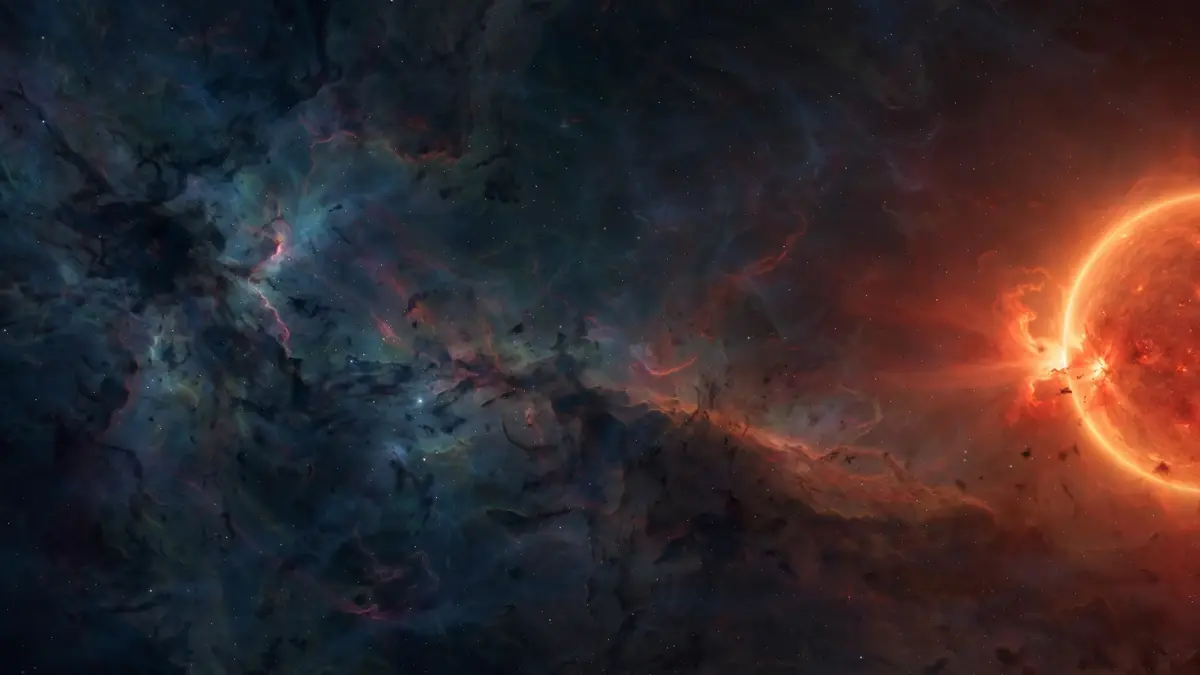
Mainstream physics agrees the universe will not last forever — stars burn out and entropy rises. The Quran described the same ending fourteen centuries ago: the sun folded up (81:1), the stars falling (82:2), the seas set ablaze (81:6), the earth shaken (99:1). The overlap is real, but never force a verse onto a headline — Baghdad's Mongol lesson still stands.
Two Stories About the End
There is something unsettling about agreeing with your opponents — and on one point, modern physics and the Quran fully agree. Both say this universe is moving toward an end. A cosmologist will tell you that stars burn through their fuel, that entropy is always rising, and that the cosmos as we know it cannot run forever. The Quran said the same thing, in language far older and far grander, fourteen centuries before the first telescope. But agreement stops there. Science tries to describe HOW the end might come. The Quran tells us WHY it must come — and who decides when. This article keeps both stories honest: it states the science as mainstream physics actually holds it, and it presents the Quran's verses exactly as they stand, without forcing one story onto the other.
How Science Sees the Stars Dying
Start with what astronomers can observe, not guess. Stars shine because they burn fuel — hydrogen fusing into helium in their cores. That fuel is finite. When it runs out, a star like our sun will swell into a red giant, then collapse toward a dense ember. Mainstream astronomy gives our sun a lifespan measured in billions of years — a span so vast it makes human history look like a single breath. Bigger stars burn faster and die more violently. Everywhere we look, the lights are being spent. No physicist pretends the universe is eternal. The only debate is about which ending comes, and how the clock reads between now and then.
The Cold Fade: Heat Death in Plain Words
One leading scenario is called heat death — though the name sounds more dramatic than the idea. It simply says that everything tends toward sameness. Energy spreads out, order dissolves, and the universe keeps expanding until the distance between stars grows too great for anything to happen. No bang, no fire: just a long, slow fade into cold and darkness. It is worth saying plainly that this is a model, not a fact. Other scenarios exist, and physics is honest that it cannot predict the actual fate of the universe with certainty. Models describe possibilities. They do not issue decrees.
- Stars exhaust their fuel and go dark over billions of years
- Expansion carries galaxies further apart, cooling what remains
- Entropy — the tendency of order to dissolve — never reverses
- No current model can name the actual final hour
But the Quran Said It First: The Sun Folded Up
Long before anyone measured a star's fuel, the Quran opened Surah At-Takwir with a single, breathtaking line: when the sun is folded up (Quran 81:1). Commentators explain the verse as describing the sun losing its light and collapsing — the very fate astronomy assigns to stars like ours, only described in one verse instead of one textbook. This is not a scientific formula; it is a revelation of the outcome. Where the physicist computes how long the fuel lasts, the Quran simply declares the light will be folded away. The believer's point is not that the Quran was 'doing physics' — it is that the end of the stars was known to the One who created them, and announced in the clearest terms.
Stars Falling, Seas Boiling, Earth Shaking
The Quran's cosmic end-imagery is consistent, detailed, and unmistakable. In Surah Al-Infitar: when the stars fall and scatter (Quran 82:2). In Surah At-Takwir again: when the seas are set ablaze (Quran 81:6). In Surah Az-Zalzalah: when the earth is shaken with its mighty shaking (Quran 99:1). And in Surah Al-Ambiya: the Day We shall roll up the heaven like the rolling up of a scroll for writing (Quran 21:104). Each verse is precise about its own imagery and none of them reads like poetry invented to frighten — they read like descriptions of a reality the speaker has already seen. Mountains are described passing like clouds (Quran 27:88). The order of this world will not fade slowly; it will be undone by command.
The Expanding Universe — and an Honest Debate
This is the verse everyone asks about: And the heaven — We built it with strength, and We are indeed expanding it (Quran 51:47). Many modern readers see in it a striking correspondence with the discovery that the universe is expanding — a fact unknown to any human fourteen centuries ago. But intellectual honesty requires the other half of the sentence. Classical commentators understood the verse as describing Allah's power in creating and maintaining the heavens, and not all of them connected it to cosmic expansion. So here is the fair position: the verse is remarkable and may well point to expansion, but it should not be sold as settled proof. The Quran does not need the validation of shifting scientific models — and tying every verse to current theories is a losing game, because theories get updated.
The Mongols: What Happens When We Force the Text
History offers a warning every reader of these verses should hear. When the Mongols swept in from the east in the thirteenth century, countless, unfamiliar, terrifying, many Muslims in Baghdad — including some scholars, as Imam Ibn Kathir records in Al-Bidayah wan-Nihayah — declared them Yajooj and Majooj, released from behind their wall. The hadith says no power can stand against Gog and Magog, so the defenders lost heart before the fighting began. Baghdad fell in 1258, and historians wrote that the Tigris ran red, then black. The Mongols were not Gog and Magog. The text had been forced onto an event it never named, and the cost was a city's courage. The rule survives every century: never fit a verse or hadith onto a headline. Wait for the sources to speak for themselves.

Two Clocks, Two Jobs
It helps to think of it as two clocks keeping different time. The physicist's clock measures fuel, entropy, and expansion — the machinery of how creation runs down. The Quran's clock measures something else entirely: the decree of the One who set the machinery in motion. And on His scale, time itself works differently — for a day with your Lord is like a thousand years of what you count (Quran 22:47). So when the Quran says the Hour is near, it is not competing with astronomy's billions of years. It is speaking from the perspective of eternity, where the entire span of the universe is short. Science describes the engine. Revelation names the destination — and the Judge waiting there.
- Physics models possibilities; revelation announces certainties
- The sun's burnout is a mechanism; the folding-up is a decree
- A thousand-year day (Quran 22:47) resets every human timeline
- Agreement on 'an end' does not mean agreement on 'the end'
Why Science Cannot Answer the Real Question
Here is where the honest physicist and the honest believer shake hands and part ways. Science can propose that stars die and that entropy rises, but it cannot tell you what comes after the end it predicts. The Quran can — and does: annihilation is followed by resurrection, and resurrection by judgment. That second half is outside physics entirely, because no instrument can measure it. This is also why reducing the end times to a purely scientific event would be a mistake. If the universe merely faded, there would be no reckoning. The Quran's insistence is the opposite: the end is not an accident of physics; it is an appointment. And an appointment implies One who keeps it.
What the Believer Actually Does With All This
So what changes on a Tuesday morning, after reading about dying stars and folded suns? Nothing in your schedule — and everything in your priorities. The classical scholars drew one practical lesson from the end-times knowledge: it is for preparation, not prediction. You do not gain faith by winning debates about cosmology; you gain it by living as though the appointment is real. The Prophet taught the signs of the Hour so his followers would hold to their religion when the world went strange — not so they could build timelines. Whether the stars fade by physics or fall by command, the verdict is the same: the wise spend their limited days as if the folded sun could be their last sight of this world.
A Final Caution, From the Source Material
Every generation thinks it is the one. The people of Baghdad thought the Mongols were Gog and Magog. Modern readers feel the same pull toward climate charts, pandemics, and wars — and each new crisis arrives carrying someone's claim that THIS is the beginning of the end. Some of today's signs are real signs, taught in authentic hadith. But the Quran fixed one rule that outranks all enthusiasm: no one knows the Hour, and anyone who sets a date is inventing against the sources. Study the end of the world — in the lab reports and in the verses — and let both do their proper work: the science humbling your pride in this world, the revelation readying your soul for the next.
✅ Guide4U Islam Checklist
- Read the cosmic verses yourself: 81:1, 82:2, 21:104
- Compare science's 'how' with revelation's 'why'
- Treat 51:47 as interpretation, not proof
- Never fit a verse onto a current event
- Remember the Mongols of Baghdad, 1258
- Use the end to prepare, not to predict
Key Takeaways
- Physics and the Quran agree the universe ends — only revelation tells what follows.
- Scientific models describe possibilities; the Quran announces a decreed appointment.
- Forcing verses onto headlines has misled before — take the texts as they stand.
Frequently Asked Questions
Can science prove the Quran right about the end of the world?
Science cannot 'prove' revelation, and it should not be asked to. What we can say is that mainstream physics independently agrees the universe cannot last forever — stars burn out, entropy rises — and that the Quran described a cosmic end in detail fourteen centuries before any of this was measurable. The agreement is striking, but a believer's faith rests on the Quran itself, not on any laboratory result.
What does Quran 51:47 really say about the expanding universe?
Many readers see in it a correspondence with the discovery of cosmic expansion, and that reading is reasonable. But classical commentators also read it as describing Allah's power in building the heavens, and scholars still debate it. The honest position is to present it as a plausible, remarkable correspondence — not as settled scientific proof.
Will the universe end by heat death, or by Qayamat?
Physics proposes scenarios like heat death; it cannot confirm any of them. The Quran teaches that the universe will be undone by divine command and followed by resurrection and judgment. A believer holds the revelation's certainty while respecting science's descriptions of the mechanisms creation displays.
Should we map scientific predictions onto hadith signs?
No — and history warns against it. When Baghdad's people forced the Mongols into the Yajooj and Majooj narrations, the result was disaster in 1258. Verses and hadith must be taken as they stand, from the Quran and authentic narrations, never squeezed onto current events.