
What Is Fitna in Islam? The Trials the Prophet ﷺ Warned Us About — From the Khawarij to the Mihna

Quick Answer
In Islam, fitna means a trial by fire — a test that reveals what a person is made of. The Prophet ﷺ warned that trials would rain down like rain (Bukhari 7060), that some would flip faith overnight (Muslim 118), and that misguided groups like the Khawarij would keep reappearing until the Dajjal (Ibn Majah 174). The defense is simple: knowledge from the Quran and authentic hadith, and good deeds done while the sky is still clear.
What the Word "Fitna" Really Means
In everyday Urdu, fitna has shrunk into a label for a troublemaker — someone who spreads disorder. But the Arabic word is far wider and far deeper. Its root is the smelting of gold: metal thrown into fire so that what is pure survives and what is false burns away. That is what a fitna is — a trial by fire that reveals what a person is made of. The Quran uses it that way: "Know that your wealth and your children are a fitna for you" (Quran 8:28). Children are not evil, and wealth is not evil — but both are tests. So the first lesson is simple and changes everything: a fitna is not necessarily a punishment, and it is not necessarily a person. It is an examination, and like every examination, it has both a grader and a result.
Fitna Is Worse Than Killing — What Does That Mean?
The Quran says something startling: fitna is worse than killing (Quran 2:191). Read carelessly, that sounds extreme — but the mainstream scholars explain it plainly. The verse came in a context of persecution: when believers were being driven from their homes and blocked from their faith, the oppression that pushes people away from Allah's religion was described as a graver wrong than physical killing, because killing takes a life while fitna attacks the faith itself — the very thing that gives life meaning. The lesson for us is sobering: the most dangerous trials are rarely physical. The trial that tempts a man to sell his religion for a small price is, in the Quran's moral arithmetic, a heavier matter than the one that threatens his body. That is why the Prophet ﷺ feared for his followers' faith far more than he feared for their lives.
Believer in the Morning, Disbeliever by Evening
Among the most chilling hadiths about fitna is the one narrated in Sahih Muslim (118): trials will come like pieces of a dark night, until a man will be a believer in the morning and a disbeliever by the evening, or a believer in the evening and a disbeliever by the morning — selling his religion for a small worldly price. Notice what is being described: not a slow drift over years, but a flip that can happen in hours. A single offer, a single fear, a single desire can turn a person inside out. That is why the hadith's command is not to predict but to act: "Race to do good deeds before trials like pieces of a dark night appear." The defence against fitna is speed — good deeds done now, while the sky is still clear, because no one can run fast in the dark.
Trials Will Rain Upon Your Homes
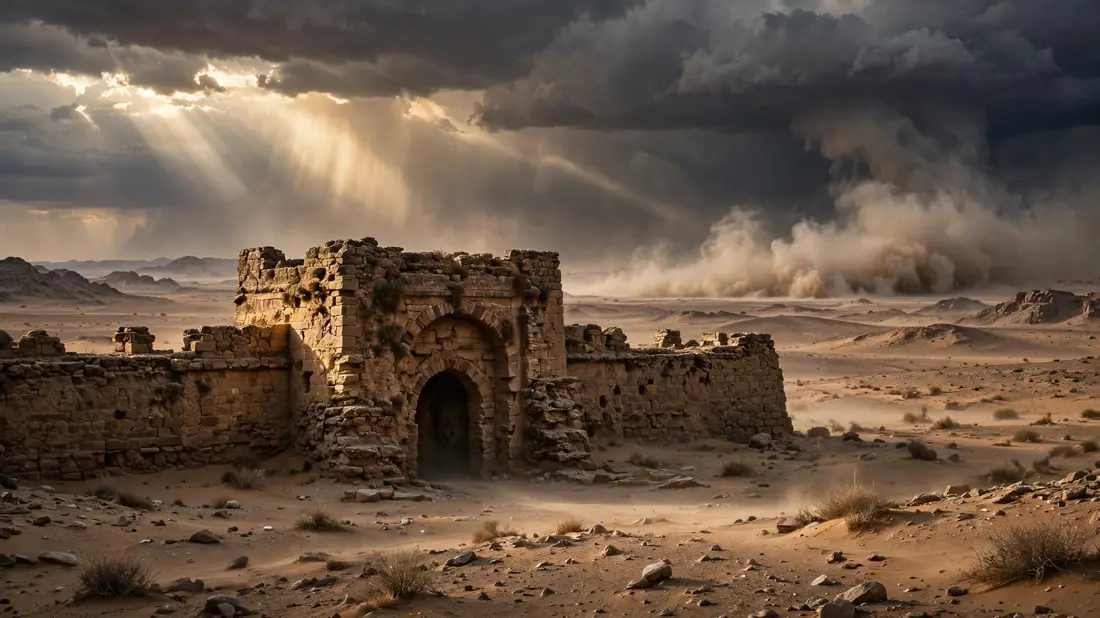
The Prophet ﷺ once climbed a high place in Medina and asked his companions: do you see what I see? When they said they did not, he told them that soon trials would fall upon their homes like rain falls — countless, all at once, one after another (Sahih al-Bukhari 7060). Pause on the image. Rain does not ask permission. It finds every crack, covers every street, and comes in waves that keep coming long after the first shower. That is the Prophet's ﷺ picture of our age: not one great test you can prepare for and be done with, but a weather system of trials — moral, ideological, political — arriving in succession. And just as people prepare for rain with roofs and umbrellas, believers prepare for fitna with the only shelter that holds: knowledge of the Book and the Sunnah before the storm arrives.
The Khawarij: The First Ideological Fitna
In Ali's era, the first great ideological fitna of Islam appeared: the Khawarij. Their method was simple and terrifying — they took Quranic verses revealed about disbelievers and applied them to Muslims, then declared everyone outside their group to be disbelievers. Their worship was extreme; their prayers and fasting would make an ordinary Muslim's look small. But the Prophet ﷺ had described people of exactly this description — whose recitation of the Quran would not pass their throats — in narrations recorded in Sahih al-Bukhari and Sahih Muslim. When they began killing Muslims who would not join them, Ali fought them at Nahrawan. Here is the part that matters for us: this was not a one-time event. The Prophet ﷺ said they would keep appearing, generation after generation, until the last of them joins the Dajjal (Sunan Ibn Majah 174). Fitna wears new clothes in every century — but the test is the same.
The Mihna: When the State Tried to Rewrite Belief
In the year 833 CE, a trial came from an unexpected direction: the government itself. Caliph al-Ma'mun, impressed by the Mu'tazila — a school that reasoned its way into claiming the Quran's rulings were only for a specific time — decreed that every scholar and judge must accept their doctrine. This was the Mihna, the great inquisition. Scholars were imprisoned and tested; careers and lives hung on a single question. One man refused to bend: Imam Ahmad ibn Hanbal. He said the Quran's rulings stand until the Day of Judgment — and for that he was chained and lashed for years, yet did not change a word. The trial ended only when al-Mutawakkil took the throne and lifted the decree. The Mihna teaches two lessons that every later fitna repeats: first, that official power can itself become the instrument of trial; and second, that truth does not become false because a government declares it so.
Why Fitnas Come in Waves
The sources describe something every generation has felt: as one trial ends, another begins — and each one looks like the final one. A man says, this is my destruction; then it passes, and when the next comes he says, no — this is the one. Fitna is weather, not an event. There is also a distinction that protects us from confusion: a fitna is not the same thing as a sign of the Hour. Dajjal is both — a trial and a sign. But the refusal of some regions to pay zakat after the Prophet's ﷺ death was a fitna, not a sign of the Hour: a test to be faced and ended. The distinction matters because not every disaster needs a prophecy attached to it. The believer's job in fitna times is not to match every event to a prediction — it is to stand firm, do what is right, and leave the unseen to Allah.
Hudhayfah's Principle: Know the Evil to Avoid It
Hudhayfah ibn al-Yaman — the Companion famous for asking the Prophet ﷺ about evil while others asked about good — left the governing principle of this whole subject: only the one who learns the trials in advance can hope to escape them. Awareness is the only route to safety. That is the entire reason for studying fitnas at all — not curiosity, not fear, and certainly not so we can point at our neighbors and name them as part of some prophecy. The scholars laid down a rule for this study: take knowledge only from the Quran, authentic hadith, and the established reports of the Companions — exactly as they are, without mixing in personal interpretation. Once a clear verse or hadith arrives on a matter, no one's opinion carries weight beside it. Study the trials to protect your faith, not to decorate your arguments.

How to Survive Fitna Times
So what does survival actually look like? The sources give a practical list. First, hold to the Book and the Sunnah — the standard against which every claim is tested, from Khawarij slogans to Mihna decrees. Second, race to good deeds, as Sahih Muslim 118 commands, while conditions are still easy. Third, guard your heart with the morning and evening remembrances — the small daily fortress the Prophet ﷺ taught. Fourth, make dua to die upon faith — the trial that flips a man by evening is real, and asking Allah for a firm ending is not paranoia but Sunnah. Fifth, verify before you believe: never spread a narration without its reference, and never declare a fellow Muslim a disbeliever — the Khawarij's path begins exactly there. Sixth, follow trustworthy scholarship over viral claims. Fitna rewards the hasty and spares the deliberate.
✅ Guide4U Islam Checklist
- Study trials only from the Quran and authentic hadith
- Race to good deeds before dark times arrive
- Guard mornings and evenings with daily remembrance
- Never declare a Muslim a disbeliever — that is their path
- Check every narration's reference before sharing it
- Follow trusted scholarship, not viral end-times claims
- Remember: anyone who sets a date for the Hour is lying
Key Takeaways
- Fitna is a trial, not necessarily evil — wealth and children are called fitna too (Quran 8:28)
- Knowledge of the trials in advance is the only route to safety
- Survival is obedience, not prediction — no date-setting, ever
Frequently Asked Questions
Is every fitna a punishment from Allah?
No. The Quran calls wealth and children a fitna (8:28), and neither is a punishment — they are tests. A fitna can punish the rebellious, but it can also purify the righteous, the way fire purifies gold. The same trial that destroys one person lifts another higher. The right question is never why Allah is doing this to me, but what the correct response is — hold firm, do good, and do not despair.
Are the Khawarij still around today?
The Prophet ﷺ said they will keep appearing in every generation until the last of them joins the Dajjal (Sunan Ibn Majah 174). So the pattern survives even where the name does not: people who take verses about disbelievers and apply them to Muslims, who declare others disbelievers, and who justify violence by scripture. We do not name living groups or individuals — that would be its own fitna — but we recognize the method and refuse it.
What is the difference between a fitna and a sign of the Hour?
A fitna is a trial; a sign is a prophecy marker. Some things are both — Dajjal is the greatest trial and one of the greatest signs. But the zakat wars after the Prophet's ﷺ death were a fitna, not a sign of the Hour: a test to be faced, not a prediction to be matched. Not every crisis needs to be fitted onto a prophecy.
Will studying the End Times make me anxious?
It should not, if studied the right way. The rules: learn from the Quran and authentic hadith only, do not invent interpretations, never set dates, and study to prepare — not to predict. The Companions who heard the all-day sermon did not panic; they prepared. Knowledge of fitna is a lamp, not a weight.