
One Man for Fifty Women: The Prophecy of a World Short of Men

Quick Answer
This article explains the prophecy of one man for fifty women: the fully verified Sahih al-Bukhari 1414 narration quoted in full, and a related Musnad Ahmad account presented with an open caveat about its missing hadith number. It walks through the episode's account of how wars and population shifts echo the sign - with every figure flagged as research-cited - and closes by labeling the 'great catastrophe' reading as scholarly discussion, never fact.
The Prophecy, Stated Exactly
Among the minor signs of the Hour, one narration is strikingly concrete. In Sahih al-Bukhari, number 1414, Abu Musa al-Ash'ari reported that the Prophet ﷺ said: 'A time will come upon the people when a person will wander about with gold as Zakat and will not find anybody to accept it, and one man will be seen followed by forty women to be their guardian because of scarcity of men and great number of women.' Two pictures sit inside this one narration: wealth so widespread that zakat finds no taker, and a population so changed that a single man is followed by forty women in his guardianship. The reason is stated in plain words: a scarcity of men and a great number of women. It is quoted here in full, so every reader can see exactly what the narration says and what it does not say.
- Wealth without recipients: a person carries zakat in gold and finds no one to accept it
- A changed population: one man followed by forty women under his guardianship
- A stated cause: scarcity of men and a great number of women
A Second Account, With an Open Caveat
Anas ibn Malik is reported to have described a connected scene. According to a narration in Musnad Ahmad, the Messenger of Allah ﷺ said that rain would fall from the sky yet the earth would yield no produce, and that a time would come when one man would be responsible for fifty women. In the most haunting detail of this account, a woman passes her husband and wonders who is responsible for her now. Here we must be honest about our sources: the episode's research cites this narration without a verified hadith number, and we report it exactly that way. We guess no number and invent none. Authentic material is quoted with care, and material we cannot verify is presented with the caveat written openly. That haunting detail - the woman, the husband, the unanswered question - stays with the caveat. The open caveat is not a weakness of this article; it is the point.
What 'Guardian' Actually Means
The word at the center of the prophecy is not 'husbands' but guardians. The narration says the forty women stand under a man's guardianship (qawamah): care, protection, and responsibility toward the women of his household, his relatives, and those left with no one. This is why commentators read the narration as a picture of a society, not a marriage ruling. In a world where men are few, women turn to the nearest responsible man for shelter and support, and one man ends up carrying the trust of many. The sign describes a social condition: families thinned, communities emptied of their men, and heavy responsibility resting on the few who remain. Read this way, the prophecy is about a demographic wound, not a legal curiosity - and it keeps its force without any invented detail. Nothing in the wording suggests a new ruling; it suggests a new reality, and commentators have treated it as such.
A Glimpse From the Last Century
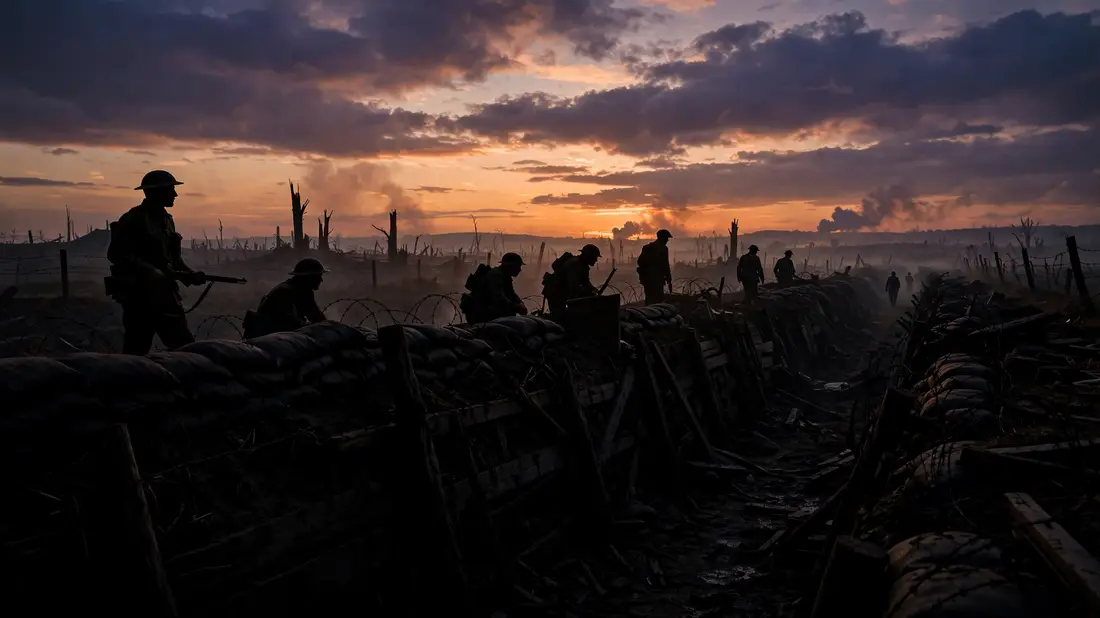
The last century has already shown the world small, painful drafts of this picture. The episode's research states that the First World War killed around ten million European men, and that in its aftermath women outnumbered men by about thirty percent in the affected lands. We repeat these figures exactly as the research gives them; the episode itself flags some of these numbers as not independently verified, so they stand here as figures cited in the research, not as settled facts. Even taken as stated, they describe something real: villages of women left without brothers, husbands, or sons, and a generation that learned what a society short of men feels like. The prophecy speaks of forty to one - far beyond any war's aftermath - which is why the sign remains ahead of us, not behind us. That generation learned, at terrible cost, how quickly a population can change its shape.
The Century of Mass War
The Second World War repeated the lesson on a larger scale. The episode's research puts the number of men killed at more than fifty million, and points to Russia today as a living echo of the imbalance, with roughly 115 women for every 100 men. As before, these are figures cited in the research, not claims we have verified ourselves. Whether or not one accepts the exact numbers, the pattern is plain to any student of modern history: war harvests men, and the societies left behind carry the shortage for generations. Yet even Russia's imbalance is a whisper beside the prophecy's ratio. That gap is the point the narration itself makes: this is not the ordinary tilt of a post-war census but a future condition so extreme it needs its own sign. History gives us echoes; the sign waits for its full form. The prophecy's number stands far above even that loss, which keeps the sign firmly in the future.
- More than fifty million men killed in the Second World War, as stated in the episode's research
- Russia today: roughly 115 women for every 100 men, also research-cited
- The pattern: war harvests men, and societies carry the shortage for generations
A Ratio Running the Other Way
Not every region tilts the same way. In parts of the subcontinent, the ratio runs in the opposite direction: a preference for sons, joined with the ultrasound era and sex-selective abortions, has left more boys than girls. The episode's research notes the legal response - India banned the practice in 1994 and Pakistan in 1997 - and we pass those dates on with the same flag: stated in the research, not independently verified. The reversal matters because it proves the deeper point: human choices and human tools can bend the natural balance of a population within a single generation. If the small decisions of one era could skew a subcontinent, the prophecy asks us to imagine what larger forces could do to the world as a whole. Today the skew itself is studied as a warning about how fragile the natural balance can be.
Today's Balance Makes the Prophecy Striking
Today the world looks almost perfectly balanced. The episode's research places the global population at about 8.2 billion, with roughly 50.25 percent men and 49.75 percent women - presented, like the other figures, as research-cited rather than independently verified. That near-parity is exactly what makes the prophecy startling. It does not describe the world we see from our windows; it describes a world this balanced one must first become. The sign is a forecast of change, not a portrait of the present, and its power lies in the contrast. From where we stand, with the numbers nearly even, the road to forty women for one man is long. The prophecy says the road will be traveled - and leaves the traveling of it to the decree of Allah alone. That contrast is the quiet power of the sign: it asks a balanced world to picture its opposite.
How Scholars Discuss the Mechanism
How could such a thing come about? Some scholars discuss the idea of a great catastrophe - a devastating war, a sweeping pandemic, or some other trial - as a possible mechanism behind the shift. This is scholarly discussion, not revelation, and it must never be repeated as fact. The narrations describe the outcome; they name no cause, set no date, and promise no timetable. Turning guesses about the mechanism into knowledge would be exactly the kind of speculation the tradition warns against. What the scholars' discussion usefully models is restraint: the best of them say 'this is a possible reading,' and stop there. We follow the same line here. The sign is real in its text, open in its interpretation, and unknowable in its timing - and there our certainty ends. Silence about the cause is part of the narration's own restraint, and we keep to it.

What the Sign Asks of the Living
If the sign looks toward a world short of men, it also speaks to the world we inhabit now. Every society already knows widows, orphans, and women without a guardian; the duty of care the narration imagines in the future is the duty already assigned in the present. A man is a guardian of his household - answerable for its safety, its provision, and its dignity. Reading the prophecy with this in mind turns it from a curiosity about the end of time into a reminder about today: care for the vulnerable in your own community before the question is ever forced upon you. The signs of the Hour are not given so that we can count heads in the future; they are given so that our hearts turn, in the present, toward the trusts we already carry. The future sign then becomes a mirror: it shows us the work we are already failing to do.
- A man is a guardian of his household - its safety, provision, and dignity
- Care for widows, orphans, and the vulnerable in your own community now
- Signs turn hearts toward present duty, not future counting
Knowledge With Humility
The prophecy of one man for fifty women - or forty, in the wording of Sahih al-Bukhari 1414 - belongs to the knowledge of the unseen, and the believer's response to the unseen is belief without invention. We hold the narration as it is reported, we honor what it clearly says, and we leave what it does not say where it belongs: with Allah, who alone knows when the Hour will come. No commentator, no researcher, and no article can set the date, and this one will not try. What we can do is simpler and harder: take the signs seriously, live as though the trusts placed on us matter, and keep our hearts ready. That readiness - not prediction, not alarm - is the whole point of knowing the Hour draws near. May Allah make us among those who prepare with faith rather than those who speculate with noise.
✅ Guide4U Islam Checklist
- Read the Bukhari 1414 narration in full
- Note the guardian wording, not marriage
- Hold unverified numbers with open caveats
- See history's echoes without forcing the sign
- Care for widows and orphans around you now
- Set no dates for the Hour
Key Takeaways
- Sahih al-Bukhari 1414 foretells a time of such male scarcity that forty women will be under one man's guardianship.
- A related narration in Musnad Ahmad is reported with an open caveat: the episode's research gives no verified hadith number for it, so we quote it without inventing one.
- History's wars produced only faint echoes of this ratio; the sign describes a future shift, and its cause and timing remain with Allah alone.
Frequently Asked Questions
Is the number forty meant literally?
The narration says forty; the Musnad Ahmad account says fifty. Scholars read the number as an expression of extreme scarcity rather than a fixed census count, and the difference between the two wordings supports that reading. What is certain is the picture: far more women than men. Insisting on the exact arithmetic would miss the point the narration states plainly - a scarcity of men and a great number of women.
Does this narration have anything to do with polygamy?
No. The wording is about guardianship, not marriage. It describes women under a man's care and responsibility, the way dependents look to their guardian. Reading it as a ruling about marriage would put into the text something it does not say.
How reliable is the Musnad Ahmad narration quoted here?
We are open about this: the episode's research cites it without a verified hadith number, and we report it exactly that way, with the caveat written plainly in the article. The Sahih al-Bukhari 1414 narration, by contrast, is fully verified and quoted in full. Presenting both with their proper standing is the honest way to handle them.
Have the world wars already fulfilled this sign?
They gave the world a taste of it - societies left short of men for a generation - but the ratio the narration describes is far beyond anything the wars produced. The sign, as stated, looks to the future. No one can say when or how it will unfold, and setting dates for it is not permitted.