
Safe Roads and the Fire of Hijaz: The Signs of Peace and Flame
Quick Answer
Two signs close this episode: a prophecy of perfect peace - a lone woman traveling safely from Hira in Iraq to Mecca (Sahih al-Bukhari 3595), witnessed by Adi ibn Hatim himself - and a prophecy of fire from Hijaz lighting the necks of camels at Busra in Syria (Bukhari 7118, Muslim 2902). In 1256 CE, a great eruption east of Medina fulfilled the fire narration before the eyes of Imam Nawawi. Scholars discuss a future return of such peace; its timing is scholarly discussion, never fact.
Two Signs That Sound Like Opposites
The closing section of this episode pairs two prophecies that seem to belong to different worlds. One promises perfect peace: roads so safe that a lone woman can travel hundreds of miles fearing nothing but Allah. The other promises a terrifying fire: flames erupting from the land of Hijaz, bright enough to light up the necks of camels in distant Syria. Peace and fire, safety and inferno, side by side in the same list of signs. The pairing is deliberate, and it corrects a common misunderstanding: the signs of the Hour are not a catalog of disasters. Some are mercies. Some have already happened while the world watched. And each one, fulfilled or awaited, is a signature of the Prophet's truthfulness written across history - there for anyone willing to read it.
Two Complaints at the Prophet's Door
The peace prophecy begins with an ordinary scene. Adi ibn Hatim - the son of the famous Hatim Tai, known across Arabia for his generosity - was sitting with the Prophet when two men arrived with two complaints. One complained of poverty and destitution; the other complained of highway robbery, of roads made unsafe by bandits (Sahih al-Bukhari 3595). The Prophet turned to Adi and asked him a question that must have seemed strange: "Adi! Have you been to Al-Hira?" Adi answered that he had not seen it but had heard of it. Hira was a small settlement near Kufa, in Iraq - hundreds of miles of dangerous road away from Mecca. Adi knew those roads well, and his silent doubt about the robbers of Tai shows he grasped how impossible the promise sounded. The Prophet did not argue with him. He simply described a future Adi would live to see.
The Woman in the Howdah
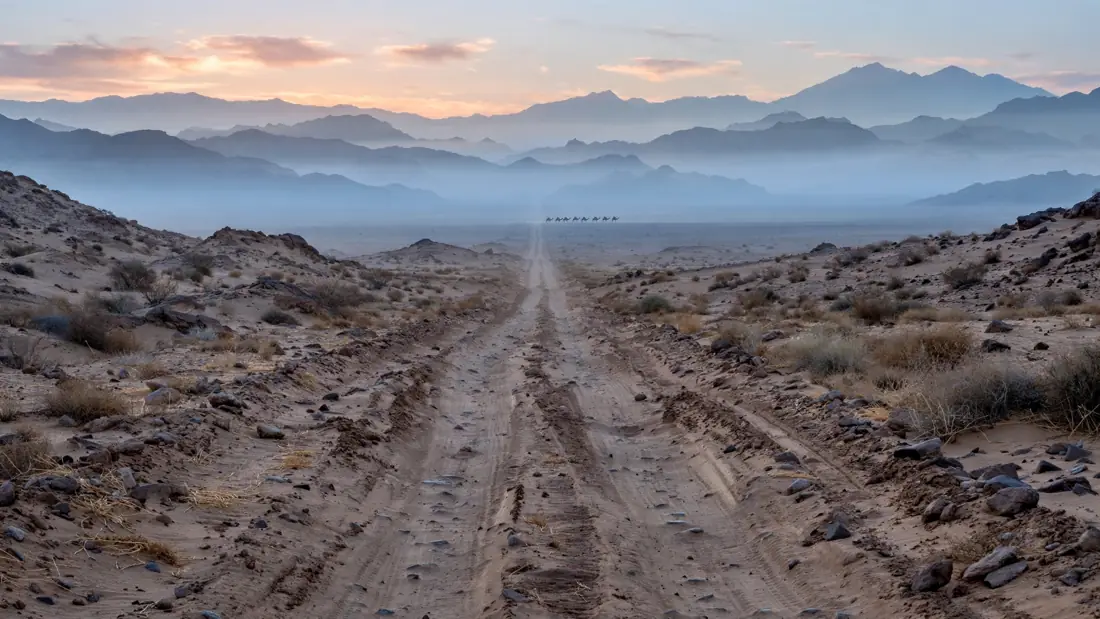
The Prophet said: "If you should live for a long time, you will certainly see that a lady in a Howdah traveling from Al-Hira will safely reach Mecca and perform the Tawaf of the Ka'ba, fearing none but Allah." (Sahih al-Bukhari 3595). Consider what this meant to its first hearers. A howdah is the covered seat carried on a camel's back - and the traveler here is a woman, alone, crossing the desert from Iraq to Mecca. In an age when Adi himself wondered inwardly what would become of the robbers of his own tribe of Tai, who had "spread evil throughout the country," the prophecy described the complete disappearance of the danger. Not fewer robbers. Not safer caravans. A single woman, traveling alone, fearing no one but Allah. It is a picture of trust restored to the world - a safety no police force has ever fully delivered, promised as a gift of the last times.
Adi Saw It With His Own Eyes
This is where the narration becomes extraordinary, because Adi ibn Hatim lived to report its fulfillment. Years later, he said: "I saw a lady in a Howdah traveling from Al-Hira till she performed the Tawaf of the Ka'ba, fearing none but Allah." The prophecy was not left hanging in the future; its first fulfillment arrived within the lifetime of the man who heard it. The same narration carried two more predictions, and Adi confirmed those as well: the treasures of Khosrau, son of Hurmuz - the Persian emperor - were opened, and Adi added, "I was one of those who opened the treasures of Khosrau." When a single narration delivers this precisely, on events its hearers lived to witness, it stops being a claim and becomes evidence. Adi's testimony is the seal on the narration: the man who doubted in silence became the witness who confirmed aloud.
Peace Once, Peace Again
The episode's research draws a careful conclusion from this: such complete peace occurred once in the era of the Companions, and the narrations indicate it will occur again. This is where careful reading matters. Some scholars hold that a future age of profound peace and security will arrive - with scholarly discussion placing it in the time of Imam Mahdi or of Prophet Jesus, peace be upon him - but that placement is scholarly discussion, not established fact, and it belongs to later episodes of this series. What the narrations establish firmly is the pattern: the Prophet described a peace so total it seemed impossible, history delivered it once, and the texts point to its return. No dates, no schedules - only the pattern, and the pattern is enough.
The Fire of Hijaz
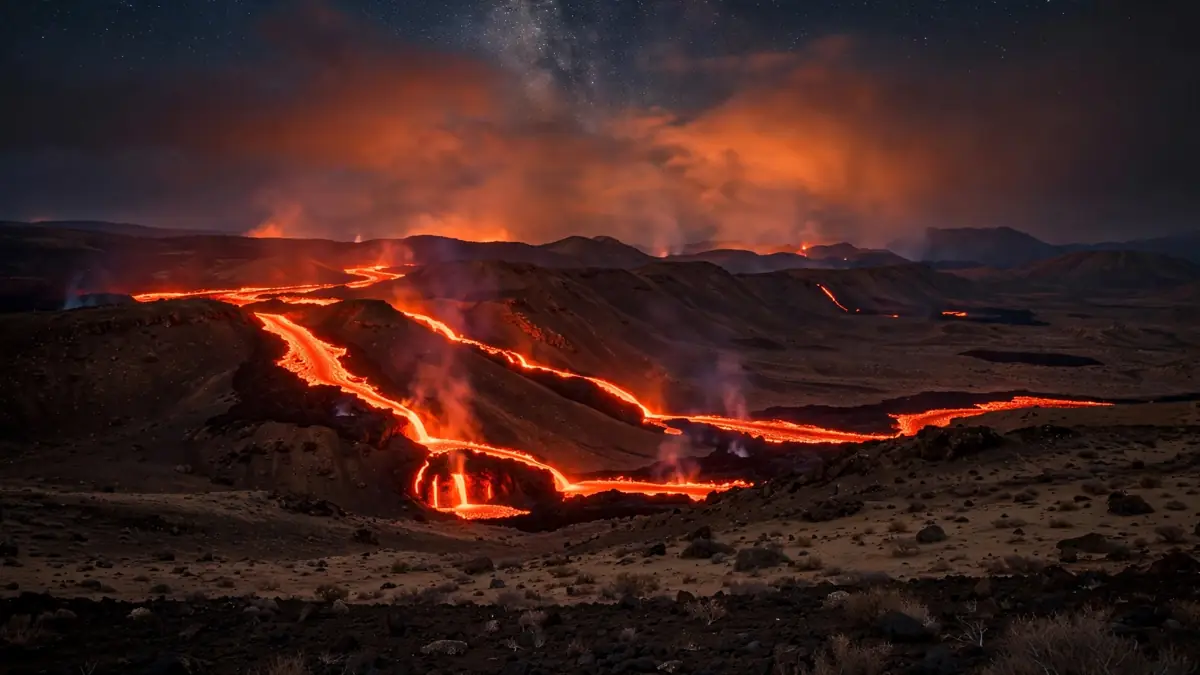
Then the episode turns from peace to flame. Abu Hurairah reports that Allah's Messenger, peace and blessings be upon him, said: "The Hour will not be established till a fire will come out of the land of Hijaz, and it will throw light on the necks of the camels at Busra." (Sahih al-Bukhari 7118; Sahih Muslim 2902). Al-Bukhari placed it in his Book of Afflictions under the chapter "The coming of the Fire." The geography is precise: the fire emerges from Hijaz, the western region of Arabia around Mecca and Medina, and its light reaches Busra - a historic city in Syria, hundreds of miles to the north. For fourteen centuries, readers of this narration waited to see whether the earth itself would confirm the words.
The Year 1256
In the year 1256 CE (654 AH), it did. Historical records describe a great eruption east of Medina - fire and flowing lava bursting from the volcanic fields, lighting up the night sky for miles around. The most remarkable witness was Imam Nawawi, the great scholar of hadith, who was living through it in the town of Nawa - only about sixty kilometers from Busra, which is why he is called al-Nawawi. He reported seeing the fire with his own eyes: a massive blaze east of Medina, visible from the mountains of Busra, so bright that even at night the necks of camels appeared illuminated. Read the narration again - "it will throw light on the necks of the camels at Busra" - and then read the eyewitness. Six hundred years apart, the two descriptions match like a lock and its key.
Why Busra Matters
Busra was not a random point on the map. The episode's research notes that this is the same historic Syrian city where the monk Bahira recognized the young Prophet Muhammad during his trading journey with his uncle Abu Talib - and warned Abu Talib of the dangers awaiting the boy, urging him to take him back to Mecca. Think about that symmetry. The city that once hosted the monk who saw the signs of prophethood in a young boy would, more than six centuries later, host the light of a fire that proved that prophethood to the entire world. Prophecy has a way of choosing its landmarks. When the narration named Busra, it named a city already woven into the Prophet's story - and then the fire came, and wove it in a second time.
What Fulfilled Signs Teach
The Fire of Hijaz belongs to a special category: a sign the ummah has already watched come true. Fulfilled signs do something no argument can do - they convert history into testimony. The narration did not merely say a fire would come; it named the land, the direction of its light, and the detail - the necks of camels at Busra - that an eyewitness later confirmed. That is not a lucky guess about geology. But fulfilled signs also carry a warning label. They do not tell you when the remaining signs will arrive, and they do not turn believers into fortune-tellers. They tell you that the One who described the fire of 1256 with perfect accuracy also described everything else - and that the correct response to a proven prophet is not curiosity about dates, but preparation for what he said is coming.
Two Signs, One Message
Put the two signs together and the episode's message comes into focus. The safe roads show that the Prophet could describe a mercy no one thought possible - and history delivered it. The fire shows that he could describe a terror no one could imagine - and the earth delivered it. Peace and flame, both announced in advance, both confirmed by witnesses. The narrations were not given so that anyone could calculate the Hour; the Quran reserves that knowledge for Allah alone: "Indeed, Allah [alone] has knowledge of the Hour" (31:34). They were given so that when the howdah crossed the desert in safety, and when the sky over Medina burned in 1256, the believers would recognize the signature - and get ready for the rest. Episode 3 ends here, with peace behind us and fire ahead - and the series continues.
✅ Guide4U Islam Checklist
- Learn the peace narration: Bukhari 3595, the woman in the howdah from Hira
- Remember Adi ibn Hatim: he doubted, then witnessed the safe journey himself
- Know the fire narration: Bukhari 7118, Muslim 2902, fire from Hijaz to Busra
- Recall 1256 CE: the eruption east of Medina, witnessed by Imam Nawawi
- Know why Busra matters: the city of the monk Bahira's recognition
- Treat future-peace timings as scholarly discussion, never fact
- Read fulfilled signs as testimony, never as timetables
- Set no dates; Allah alone knows the Hour
Key Takeaways
- The safe-roads prophecy was fulfilled in the Companions' era: Adi ibn Hatim saw it himself.
- The Fire of Hijaz was fulfilled in 1256 CE, witnessed by Imam Nawawi near Busra.
- Fulfilled signs are testimony to the Prophet's truthfulness, never timetables for the Hour.
- Peace and fire together: the signs include mercies as well as warnings.
Frequently Asked Questions
Has the Fire of Hijaz already happened?
The historical record strongly suggests so. In 1256 CE (654 AH), a great fire with lava erupted east of Medina, and the scholar Imam Nawawi - living in Nawa, near Busra - recorded seeing it with his own eyes, its light reaching the mountains of Busra. Many scholars identify this as the fulfillment of the narration.
Will the age of safe roads come again?
The narrations suggest so. Adi ibn Hatim himself reported seeing the safe journey in his own lifetime, and the episode's research notes that scholars expect such peace to return - some placing it in the era of Imam Mahdi or Prophet Jesus. That timing is scholarly discussion, not established fact, and no dates may be set.
Why would peace be counted as a sign of the end times?
Because signs are markers of an era's character, not only warnings of disaster. An age in which even the roads are safe - in which a lone traveler fears nothing - marks a world transformed. Peace, too, can be a sign: it tells you what kind of time you are living in.
Is the Fire of Hijaz the same as the final great fire?
No. The Hijaz fire of 1256 was a fulfilled sign of the approach of the Hour. The narrations of the end times mention other fires in other contexts, including a great fire near the very end that gathers people. This guide covers only the Hijaz fire named in Sahih al-Bukhari 7118 and Sahih Muslim 2902.