
What Is Al-Malhama Al-Kubra? The Great Battle Before the Hour, Explained
Quick Answer
Al-Malhama Al-Kubra is the Great Bloodshed, the greatest battle in human history, which the narrations place before the Dajjal's emergence. After a treaty with the Romans breaks at a meadow where the cross is raised and smashed, the Romans land at Dabiq and Amaq while the Muslims gather at Ghouta near Damascus. One third of the Muslim army flees, one third is martyred, and one third wins and never faces trial again.
The Name: Al-Malhama Al-Kubra
The phrase itself tells you how to picture it. In Arabic, malhama means a battle of terrible slaughter, and al-kubra makes it the greatest: the Great Bloodshed. The narrations place it before the emergence of the Dajjal, the false messiah, which makes it one of the great wars that lead the world toward the final signs. The episode describes it as the greatest battle in human history, a war in which the Muslim world stands united against a single enemy, unlike the scattered conflicts of our own time. I want to treat that description with care. The narrations speak of unprecedented bloodshed and of armies so vast the earth itself seems crowded, but the narrations do not give casualty figures or dates. What they give is sequence and scale: a peace that breaks, a gathering at named places in Syria, and then a bloodshed the narrators of the episode call unmatched since the first war on earth.
The Red Storm Over Kufa
The Companions themselves watched for this war long before it was written into books. Once, a red dust storm swept over Kufa and turned the sky the color of rust. A man ran to Abdullah ibn Mas'ud crying, 'Has the Hour come?' Ibn Mas'ud was reclining on a pillow, and at that question he sat upright. No, he answered: the Hour would not come until an enemy wages war against the whole Muslim world, and all of Islam unites against it. He pointed toward Syria and named the Romans. A word on honesty: this series lives or dies by it. Sahih al-Bukhari 4999 is cited here for one fact only, that Ibn Mas'ud was among the four the Prophet, peace be upon him, told the people to learn the Quran from. The episode gives no collection for the war narration, so I will not pretend it did. Independent verification places it in Sahih Muslim 2899a; here is what it contains.
- No one will rejoice over the spoils of war, and no inheritance will be distributed.
- Detachment after detachment will march out fighting, willing to die to the last man.
- A bird flying over their battle lines would fall dead before it could cross them.
- Of a hundred relatives, only one will remain alive.
- A false cry will spread that the Dajjal has come out among their families.
- Ten horsemen will be sent ahead as scouts: the Prophet knew their names, their fathers' names, and the colors of their horses, and he called them the finest riders on earth that day.
The Treaty with the Romans
The path to the great bloodshed begins, astonishingly, with a peace treaty. Dhu Mikhbar narrated, in Sunan Abu Dawud 4292, that the Prophet, peace be upon him, said the Muslims would make a secure peace with the Byzantines, then fight together with them against a common enemy. The sources do not name that enemy, and this series will not guess: only Allah knows. The narration promises victory and safety, and for a time that is what holds. But after the victory, at a meadow with mounds, a Christian lifts the cross high and declares that the cross has prevailed, and a Muslim rises in anger and smashes it. That single act is the spark. From that moment the narration says treachery begins, and the Muslims must brace for the war that follows. Scholars have discussed this treaty for centuries, and their point endures: the final great war is not sparked by unprovoked aggression but by betrayal after trust.
Eighty Banners of Twelve Thousand
The numbers attached to this battle are staggering, and they need careful handling. The episode quotes the figure of eighty banners, each of twelve thousand fighters, and here is a correction that matters: that figure comes from Sahih al-Bukhari, in the narration of Awf ibn Malik from the Tabuk expedition, not from Sunan Abu Dawud 4292 as the episode's sourcing implies. Eighty times twelve thousand is nine hundred and sixty thousand men on one side of the field. The episode then draws a modern comparison, likening the Roman force to today's NATO, and measures a million men against a shrunken world population to stress how immense that army would be. Both of those moves must be labeled for what they are: the episode's interpretation, not the hadith's text and not established fact. The narration gives the banners and the thousands; the rest is commentary.
Dabiq and Amaq
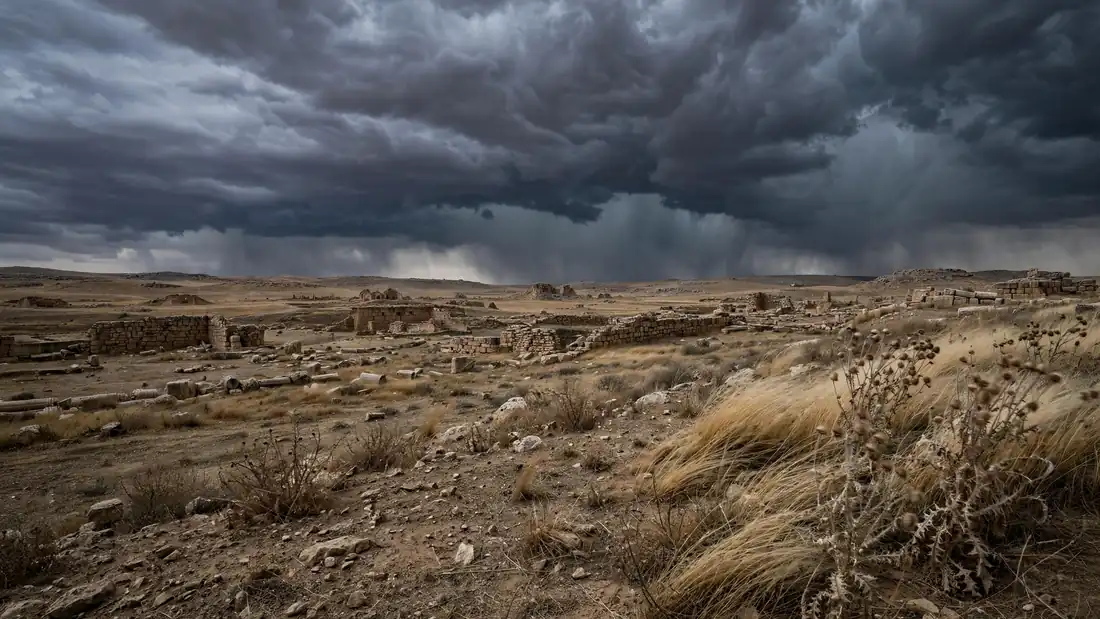
The narrations name the ground. In Sahih Muslim 2897, the Prophet, peace be upon him, said the Romans would land at al-A'maq or Dabiq. Dabiq is a town near Aleppo, close to the Turkish border, and Amaq is a valley not far from it. The episode's tactical reading goes further, describing open plains that favor massed armies, water close at hand, and firm ground underfoot. That tactical picture is the episode's account, not the hadith's wording, so take it as informed imagination rather than revelation. What the narrations do establish is geography: the decisive confrontation unfolds in northern Syria, where these names still mark real places on the map. For the believer studying these narrations, the point is not to scout terrain but to recognize the sign when the armies gather there.
The Assembly at Ghouta
Before the Romans land, the Muslims have a rendezvous of their own. In Sunan Abu Dawud 4298, the Prophet, peace be upon him, said: 'On the day of the great battle, the place of assembly of the Muslims will be in al-Ghouta, beside Damascus.' The narration calls Damascus 'one of the best cities in Syria,' a praise the episode repeats with reverence. The picture is complete and symmetrical: the enemy lands at Dabiq in the north, the Muslims gather at Ghouta beside Damascus, and the land between them becomes the field of the age. The episode reads Ghouta as the rallying ground of the Muslim command, where the best fighters assemble before the march north. That reading follows the text's geography faithfully. When the great battle comes, both sides will already know exactly where to stand.
Three Groups, One Victory
The battle's first act is a refusal. In Sahih Muslim 2897, the Romans call out to the Muslims: step aside and leave us alone with those of us who were taken captive, so we can fight them. The Muslims refuse: no, by Allah, we will not abandon our brothers for you to fight. One small sourcing note first. The episode cites Sahih Muslim 2899 for this narration, but the text belongs to Sahih Muslim 2897, which the episode itself used for the Dabiq account above; consider it corrected here. The outcome then divides the army into three. One third flees, and Allah will never accept their repentance. One third is martyred, and the narrations call them the best of martyrs. And one third stands firm and wins, a force the narration says will never be put to trial again: the conquerors of Constantinople. The refusal at the beginning is what makes the ending possible.
The Euphrates and the Mountain of Gold
There is another warning the narrations give before these wars are done, and it concerns a treasure. In Sahih Muslim 2894a, the Prophet, peace be upon him, said the Euphrates would uncover a mountain of gold, and that ninety-nine of every hundred who fight over it will be killed. The Prophet forbade his followers to take any of it: a prize that leaves nearly everyone who grasps it dead is not wealth but ruin. Whether the gold is literal metal or simply something the world desires enough to kill for, this series will not decide. That is scholarly discussion, not a ruling, and the narrations themselves do not explain the word. The lesson stands either way. When the mountain appears and the armies gather around it, the Prophet's instruction is to stay away.
Armageddon in Western Prophecy
Strange as it sounds, the non-Muslim West has been waiting for this same war under a different name: Armageddon. Everything here is the episode's account of that Western tradition, reported respectfully and without sensationalism. The episode begins with Hal Lindsey's 'The Late Great Planet Earth,' a book it credits with more than twenty-five million copies sold. It recalls President Reagan being quoted on the claim that the blood of the final battle would reach the bridles of horses two hundred miles from Jerusalem. It traces the word itself to the Aramaic 'Ar,' meaning hills, joined to Megiddo, giving 'Har Mujdon,' the hills of Megiddo. It cites Tim LaHaye's novel 'Armageddon,' credited with three million copies. And it tells the story of Father Ovil, who is said to have made eighty million dollars from the prophecy. The episode's point is not endorsement but observation: two traditions, from opposite sides, expect a final great war in the same land.
- Hal Lindsey's 'The Late Great Planet Earth,' credited with more than 25 million copies.
- Reagan's quoted remark on blood reaching horses' bridles two hundred miles from Jerusalem.
- Aramaic 'Ar' (hills) plus Megiddo gives 'Har Mujdon,' the hills of Megiddo.
- Tim LaHaye's novel 'Armageddon,' credited with three million copies.
- Father Ovil, said to have made 80 million dollars from the prophecy.
Eyes on Syria: The Order, Never a Date
The episode closes the way the narrations require: with a sequence, not a schedule. The road it sketches runs from Jerusalem flourishing in the present age, through the desolation of Medina, to the great wars themselves: the Malhama, the emergence of the Dajjal, and all that follows. No one is given a year, a decade, or a generation, and any attempt to pin the Hour to a date contradicts the plain teaching that its knowledge is with Allah alone. That is why this series repeats the rule in every episode: watch Syria, study the narrations, prepare your heart, but never set a date. The signs are given so that faith holds firm when they appear, not so that anyone can claim to know the calendar. When the great bloodshed comes, the believers will recognize it. Until then, the order is enough.
✅ Guide4U Islam Checklist
- Al-Malhama Al-Kubra means the Great Bloodshed.
- It comes before the Dajjal's emergence.
- The Roman treaty breaks at the meadow.
- Romans land at Dabiq; Muslims gather at Ghouta.
- One third flees, one third martyred, one third wins.
- Eighty banners of twelve thousand, per Sahih al-Bukhari.
Key Takeaways
- The great war begins with betrayal after trust, not aggression.
- Syria is the named land: Dabiq for the Romans, Ghouta for the Muslims.
- The narrations give sequence and signs, never a date for the Hour.
Frequently Asked Questions
What does Al-Malhama Al-Kubra actually mean?
'Malhama' is an Arabic word for a battle of terrible slaughter, and 'al-kubra' means the greatest: the Great Bloodshed. The narrations place it before the Dajjal's emergence, among the great wars that lead the world toward the Hour (Sahih Muslim 2899a). It is not one of today's conflicts; the narrations describe it as a war without precedent.
What breaks the peace treaty with the Romans?
After the Muslims and Romans fight a common enemy together and win, a Christian raises the cross at a meadow with mounds, declaring the cross has prevailed, and a Muslim smashes it in anger (Sunan Abu Dawud 4292). That betrayal ends the treaty and begins the war.
Where do the narrations say the battle happens?
The Romans land at al-A'maq or Dabiq, near Aleppo by the Turkish border, while the Muslims gather at al-Ghouta beside Damascus (Sahih Muslim 2897; Sunan Abu Dawud 4298). The land between those two points is the field of the great bloodshed.
Does the Hour come right after the Malhama?
The narrations give an order, not a date: the treaty, the great battle, and then the emergence of the Dajjal, who truly appears after the false alarm in the battle's aftermath (Sahih Muslim 2899a). No narration gives a year or a decade, and this series will never set one.