
Where Is the Ark of the Covenant? Five Theories About the Lost Chest
Quick Answer
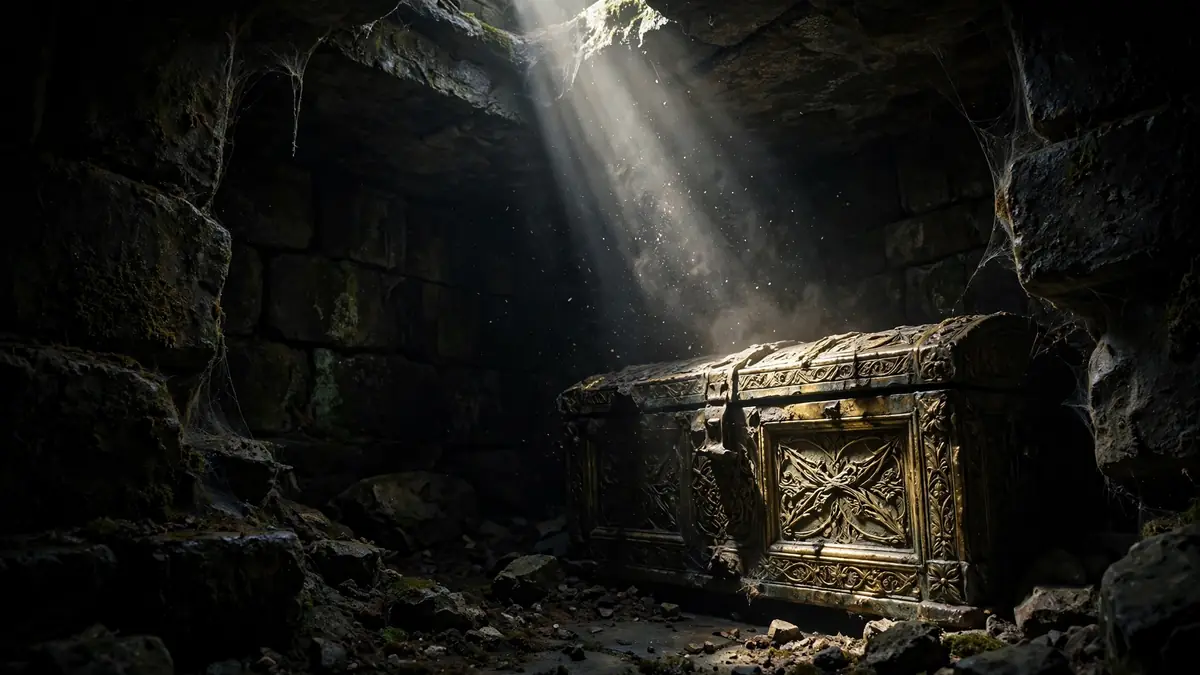
The Ark of the Covenant has been lost since 586 BCE, and five major theories claim to know where it is: Sheshonk's Egypt, Ethiopia's Aksum, the tunnels beneath the Temple Mount, the Knights Templar's France, and Jeremiah's mountain cave. The episode examines each and finds every one unproven - the Karnak inscriptions never mention the Ark, the Ethiopian room cannot be entered, the Cassius Dio story cannot be verified, the Templar records are silent, and the mountain is unknown.
Lost Twice
The Ark of the Covenant has been missing for twenty-five hundred years - and according to the episode's account, it was lost not once but twice. The first time, it came back: its return to the Israelites became the sign of Talut's kingship in Surah Al-Baqarah 2:248, as the previous article described. The second time, it vanished without a trace. Five major theories have been offered for where the Ark went: from the temples of Egypt to a sealed room in Ethiopia, from the tunnels beneath the Temple Mount to a mountain cave named by an old historical text. This article lays out the five theories as the episode presents them, marks where each one breaks down, and ends where the episode ends: with the prophecies of the Ark's return. Every generation since has produced a new answer - and every answer has faded, leaving the question standing.
The First Loss: Jericho
The first loss is reported by the episode as an account from the tafsir of Ibn Kathir - attributed, as the episode attributes it. The Israelites had begun treating the Ark as a weapon of war, certain no army could defeat them while it was with them. As a small punishment, the episode's account says, they were defeated and their enemies carried the Ark to Jericho, where it was set beneath their largest idol - until calamities struck the place, the idol was found fallen, and the frightened captors loaded the chest onto an ox-drawn cart and sent it out of their land. By Allah's command the oxen carried it back to the Israelites. The episode keeps this account in its place: tafsir material, the commentators' telling, not a verse of the Quran and not a hadith. The captive chest would return as a king's credential. The captive chest would return as a king's credential. From plunder to proof.
The Second Loss: 586 BCE
The second loss has no return. The episode gives the history as history: Nebuchadnezzar, the Babylonian king whose power was rising across the region, attacked Jerusalem in 586 BCE in the worst assault the city had ever suffered. Solomon's Temple was destroyed, and with it, the resting place of the Ark. The episode stresses the silence that followed: no mention of the Ark in Nebuchadnezzar's own records, none in the later Jewish scriptures - had he taken it to Babylon, the episode reasons, such a prize would have been displayed before his god Marduk or at court. Instead, the record simply stops. Three prophets were present at that attack, the episode says - Daniel, Ezekiel, and Jeremiah - and it is Jeremiah who carries the last and most detailed theory. What the Babylonians could not carry off, they buried in silence. The silence has now lasted twenty-five hundred years. Twenty-five centuries of quiet. The quiet has outlasted every empire since.
Theory One: Carried Off to Egypt by Sheshonk
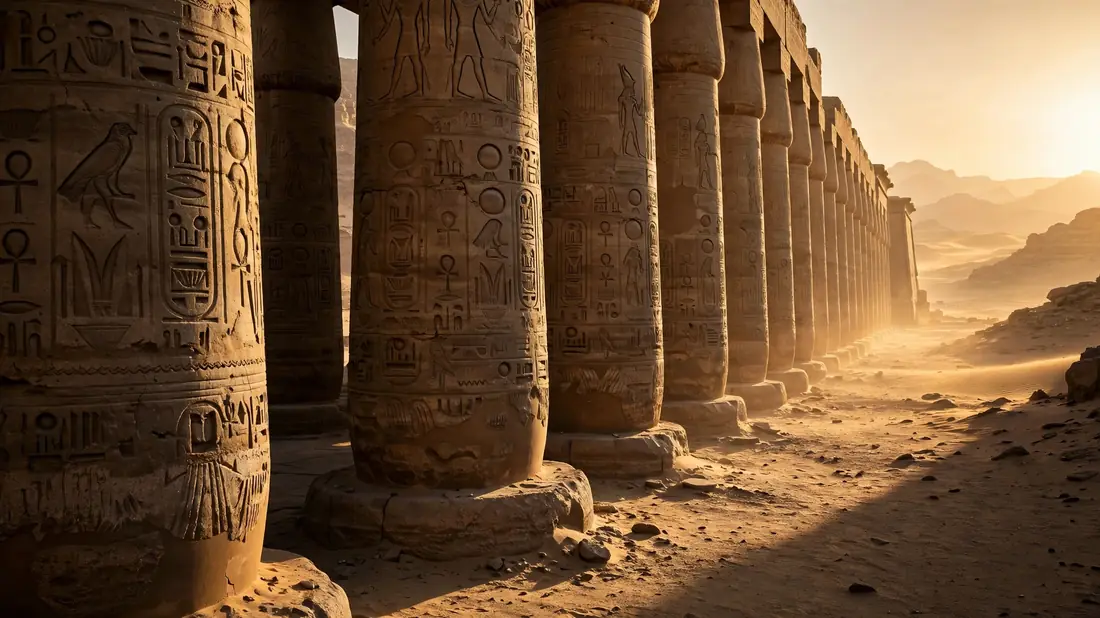
The first theory looks to Egypt. After Solomon's death, the Pharaoh Sheshonk attacked Jerusalem and stripped the Temple of its treasures - gold, silver, precious vessels, gold shields - as recorded in the inscriptions on the columns of the Karnak Temple, which the episode cites as its evidence. Since the Ark sat inside that Temple, some have speculated Sheshonk may have taken it too. The episode's answer is no, and its reasoning is worth hearing: had the Ark been carried to Egypt, it would have been the greatest tragedy in Jewish history, loudly mourned; and the Karnak inscriptions, which record Sheshonk's campaign in detail - the gold, the silver, the cities and fortresses - mention the Ark not once. Most historians, the episode reports, conclude Sheshonk looted the treasures but never reached the Holy of Holies, or the Ark was hidden before he arrived. The theory dies on the silence of the stone: the Ark is nowhere in the record.
Theory Two: Hidden in Ethiopia
The second theory is the one its believers hold most fiercely. It says the Ark was taken from Jerusalem to Ethiopia and now lies in the city of Aksum - the oldest center of Christianity in Africa - inside the Church of Our Lady of Zion. The episode reports the claim as the Ethiopian Church's senior figures make it: that an Ethiopian king named Menelik brought the Ark from Jerusalem, and it has rested in Aksum's depths ever since. The guardianship, as the episode describes it, is total: the monk assigned to the room may never leave the church premises and may never speak of the Ark; no outsider may enter; cameras are unthinkable. The episode presents all of this as the claimants' account - serious, detailed, and sealed shut. No one outside that room can verify what is inside it. A claim that cannot be examined, however sincerely held, remains a claim. Weight, though, is not evidence. Sealed shut.
Theory Three: Beneath the Temple Mount
The third theory says the Ark never left Jerusalem at all - that it lies hidden in the carved tunnels beneath the Temple Mount, under the Rock and Al-Aqsa Mosque, to this day. The episode's evidence is a striking story it attributes to the Roman historian Cassius Dio and his eighty-volume Historia Romana: during Rome's siege, Dio supposedly wrote that the Jews began guarding the Temple with extraordinary devotion, as if they had found something precious - and that one night the high priest climbed to the roof, threw keys toward the sky, and cried out to save it. The caveat, stated openly: this story cannot be independently verified, and we present it exactly as the episode attributes it - to Cassius Dio, volume sixty-five. From it, some historians derive the hidden-beneath-the-Mount theory. The episode adds the honest postscript: after the siege, the Romans found sacred artifacts in the Temple and its caves, but no Ark. The keys meant something.
Theory Four: The Knights Templar
The fourth theory moves the Ark to Europe. The Knights Templar - the warrior order headquartered on Jerusalem's Temple Mount during the Crusades, who dug beneath that hill for nine years in tunnels that still exist - grew suddenly and enormously rich afterward: ninety castles, thousands of farms and properties across Europe. Some historians, the episode says, claim they found the Ark and harnessed its power; an Ark researcher named Kathleen Coppens is cited as claiming they carried it to France and hid it under the church of Rennes-le-Chateau. But the episode itself delivers the verdict, and it is negative: the Crusade-era records - official documents, church records, papal letters, the books of European and Muslim historians - mention the Templars' treasure nowhere by name, and when King Philip arrested the order and seized everything, the long papal investigation found no trace of any such sacred object. A fascinating theory, the episode concludes - but not a convincing one.
Theory Five: Jeremiah's Cave
The fifth theory is the episode's own favorite, returning to the Second Book of Maccabees - a historical work the episode calls outside the Bible but respected as history. In its account, at the time of Nebuchadnezzar's attack, the prophet Jeremiah hid three sacred things together in a cave: the table of the sacrifices, the sacred tent, and the Ark of the Covenant. The cave was on the mountain where Moses passed away, gazing at the Holy Land - which mountain, no one knows. The candidates, the episode says: Mount Nebo in Jordan, a mountain near Madaba, mountains near the Dead Sea and Lake Tiberias - fourteen to eighteen claimed sites. It adds the remark attributed to Mujahid ibn Jubair, the student of Ibn Abbas: only four kings ever ruled from east to west, two believing and two disbelieving, one of the disbelievers being Nebuchadnezzar - reported by name, with no collection given, as the episode states it.

The Promised Return
Five theories, and the honest answer is still no one knows. That is where the episode leaves the history - and where the prophecies pick up. The last article of this series gathered them: the Kitab al-Fitan report that the Mahdi will bring the Ark with four other items, the Ibn Abbas narrations of its emergence from Lake Tiberias, and Jeremiah's sentence from 2 Maccabees 2:7-8 that it will not reappear until the command of Allah is given. The theories argue about where the Ark is hidden; the prophecies agree on what its return will mean - a sign that the Hour has drawn near. No dates are given, and none are claimed here. For the believer, what matters is not finding the chest but heeding the warning its return will carry. The chest waits; the prophecies wait with it.
✅ Guide4U Islam Checklist
- The Ark was lost twice: Jericho, then 586 BCE.
- Sheshonk theory: Karnak lists treasures, never the Ark.
- Ethiopia claim: Aksum, sealed room, unverifiable.
- Temple Mount: Cassius Dio story, cannot be verified.
- Templars: no record of the Ark in any seizure.
- Jeremiah's cave: 2 Maccabees 2:4-8, mountain unknown.
Key Takeaways
- All five theories fail the episode's own test: none has a single piece of hard evidence.
- The strongest negative evidence is documentary silence - Karnak, the Templar seizures, Nebuchadnezzar's records.
- The prophecies agree where the theories cannot: the Ark returns once, by Allah's command, before the Hour.
Frequently Asked Questions
When was the Ark of the Covenant lost?
According to the episode's account, twice. The first loss came when the Israelites' enemies captured the Ark and carried it to Jericho - but calamities struck the place until the captors sent it back, and its return became the sign of Talut's kingship (Quran 2:248). The second loss came in 586 BCE, when Nebuchadnezzar of Babylon destroyed Jerusalem. Since then, no trace has been found.
Is the Ark of the Covenant in Ethiopia?
That is the second theory examined here: senior figures in the Ethiopian Church claim the Ark was brought to Aksum and lies in the Church of Our Lady of Zion, guarded by a monk who may never leave. The episode reports the claim as the claimants make it - serious, detailed, and completely unverifiable from outside, since no one may enter the room.
What does 2 Maccabees say about the Ark?
The episode cites the Second Book of Maccabees, chapter 2: Jeremiah hid the Ark with the sacred tent and the altar in a cave on a mountain at the time of Nebuchadnezzar's attack, and verse 7-8 records his sentence that it will not reappear until the command of Allah is given. This is presented as the episode's rendering of that historical text.
Will the Ark of the Covenant ever be found?
The Islamic prophecies reported in this series say the Ark will resurface once before the Day of Judgment - brought by the Mahdi, emerging from Lake Tiberias, by Allah's command. The prophecies give no dates and no locations to dig. Until then, every theory about its hiding place remains what the episode itself calls it: a theory.