
Music in Islam: What the Quran, the Hadith and Science Say About Sound and the End Times

Quick Answer
The Quran addresses music through 'idle tales' (Luqman 31:6, sworn by Ibn Masud to concern songs) and Iblis's 'voice' (Al-Isra 17:64). The hadith of Tirmidhi 2212 attaches the end-time calamities to the prevalence of musical instruments, and science shows how sound shapes the brain — dopamine loops, over-activated nerves, dependence. The one exception is the daf, permitted within limits (Bukhari 952, Tirmidhi 3690).
Forty Thousand Years of Sound
Music is far older than most people imagine. Around forty thousand years ago, humans were already carving flute-like instruments from hollow bones — the Vogelherd flute, unearthed in excavations in Germany, survives as proof of that ancient beginning. In ancient Egypt and Mesopotamia, the lands of Sumer and Babylon, music held a spiritual status, and hymns were sung regularly. Ancient India preserved sacred songs in its scriptures, especially the Sama Veda, called the mother of ragas — the origin of words like raga, tala, and laya that survive in Indian music to this day. The Greeks were the first to treat music as a scientific study: Pythagoras discovered the mathematical ratios between musical notes. Muslim scholars carried that work forward — in the tenth century, Al-Farabi wrote a complete book, Kitab al-Musiqa al-Kabir, analysing the notes and their physics in full detail. Yet in the Prophet's own time, only one instrument was customary: the daf, played on Eid and at weddings. Music's history is long. The religious question about it is longer still.
The Quran's Words: Idle Tales
The Quran addresses the question directly. In Surah Luqman there is a verse about those who "buy the amusement of speech to mislead [others] from the way of Allah without knowledge" (31:6). The Companion Abdullah ibn Masud swore an oath that this verse was revealed concerning music and songs. Ibn Abbas gave the same interpretation, with a careful condition attached: if music distracts a person from the remembrance of Allah, or leads him toward sin, it falls squarely under the idle talk this verse condemns. The verse does not name an instrument. It names an effect: speech bought for amusement, used to pull people away from the path. That is the Quranic standard, and it is worth holding onto through the rest of this guide — because it asks about consequences, not categories.
The Voice of Iblis
Then there is a second verse, stranger and darker. In Surah Al-Isra, verse 64, as Iblis is expelled from the heavens, he is told: "And incite [to senselessness] whoever you can among them with your voice." Some commentators explain that Iblis's voice here is another name for singing and playing music — the tool of seduction that the chief seducer is explicitly granted. In the light of these two verses, the Quran's position, as the episode's research reads it, is clear. And the reasons for the prohibition divide into two categories: moral and scientific. The moral reasons are the easier ones to see. The scientific ones run deeper — and they lead, unexpectedly, back to the punishments of the end times.
The Prophetic Warning Attached to Music
The hadith of Sunan al-Tirmidhi (2212) does not leave the question of music as an abstract debate. It attaches a prophecy to it. The Prophet warned that among the conditions under which khasf, qadhf, and maskh would descend is that musical instruments become common — not rare, not exceptional, but an ordinary part of life. This is the same theme as the narration of the four things in Sahih al-Bukhari (5590), where instruments appear alongside unlawful relations, silk, and intoxicants. The connection is not accidental. The end-times narrations treat music as one of the cultural markers of the last age: a sign that sits inside the same list as the things a society stops being able to name as wrong. Whether one reads these texts as warnings about culture or as predictions, they agree on one thing: music is not a side issue in this tradition.
How Music Shapes the Listener
The moral case against music is straightforward, and it starts with what the songs say. Song lyrics shape the listener, often in shameful ways. The research behind this episode looked into recent songs and found lyrics so vulgar they cannot be repeated before a family — and such songs do not stay on the playlist. They spread a coarseness through society, teaching listeners what to want and how to speak about it. This is exactly what the Quranic phrase "idle tales" points at: speech bought for amusement that pulls people off the path. A song is not just a sound. It is a teacher with a melody, and what it teaches is repeated a hundred times a day, in the ear of someone who never chose to be taught it.
- Lyrics that glorify what the religion forbids
- Melodies that make the forbidden feel beautiful
- Constant repetition that wears down resistance
- A culture that treats modesty as outdated
What Sound Does to the Brain
The scientific case runs deeper than the moral one. High-tempo, heavy-bass music releases pleasure hormones in the brain — dopamine, in the language of science. Listened to repeatedly, the brain grows accustomed to this artificial happiness instead of natural joy. This is the state the Quran calls lahw: getting lost in heedlessness, chasing manufactured pleasure. Constant loud or fast-paced music over-activates the sympathetic nervous system, the body's alarm branch — the result is fear, anxiety, and distress, the body staying on alert all day as if in danger, producing a constant restlessness. Neuroscience shows something more: music acts on the same brain region that drugs affect. A long habit of music can create genuine addiction. Some people cannot work without music, cannot sleep without it, cannot tolerate silence. The episode's research cites a 2016 study in Frontiers in Psychology on this point, though its specific figures could not be independently verified here. And sad or melancholic songs create repetitive emotional loops in the brain, reviving the same sorrow again and again, until the listener sinks deeper into distress. Psychology calls this psychological dependence. The tradition calls it spiritual slavery.
The One Exception: The Daf
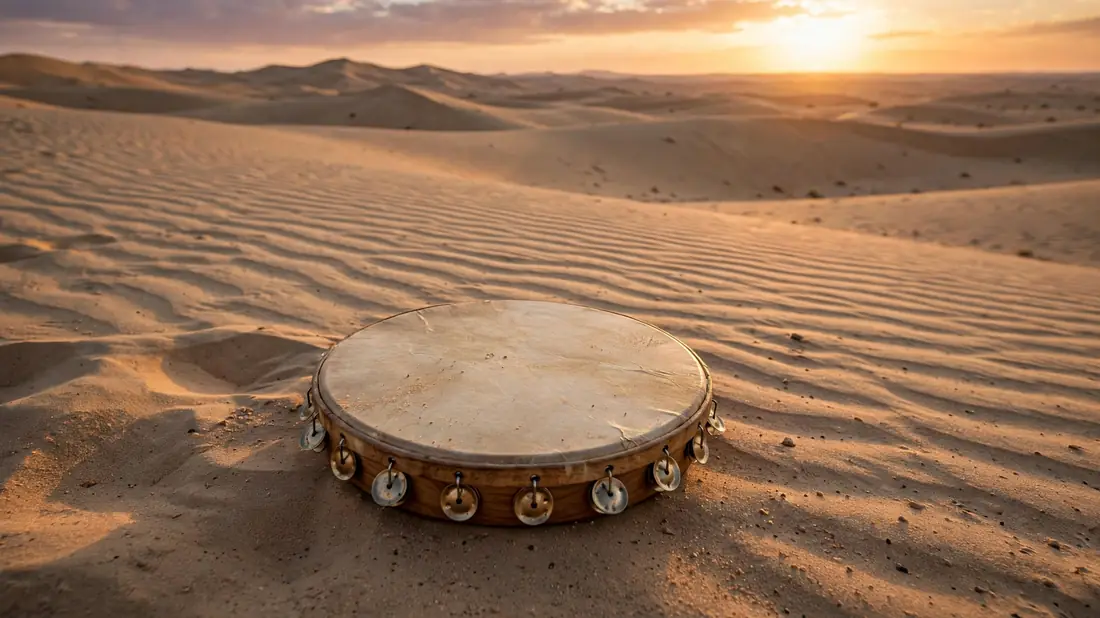
Against all of this stands the daf — an instrument the narrations permit within limits. Aisha narrates that on an Eid day, the Prophet came home to find two girls playing the daf. Abu Bakr told them to stop — but the Prophet said: let them play, Abu Bakr; every nation has an Eid in which it celebrates happiness (Sahih al-Bukhari 952). Many other narrations on the daf exist, and scholars hold it permissible within conditions. So what separates the daf from every other instrument? The answer is simplicity: the daf produces no melody, only rhythm. Its sound resembles the natural heartbeat, or the rhythm of footsteps — exciting, but within strict limits. The classical scholars put it this way: the daf is a beat, not a melody. The episode's research adds that the daf operates in the seventy to one-hundred-thirty hertz range — the range of the heartbeat and of the brain's theta waves, the state the human brain reaches in natural calm — while other instruments generate the harmonic overtones that trigger dopamine and artificial pleasure. That is the distinction the tradition draws: rhythm that echoes the body's own beat, permitted; melody that intoxicates it, warned against. One more narration sets the boundary. A black woman came to the Prophet and said she had vowed that if he returned safely from the expedition, she would express her happiness by playing the daf. He answered: if you made a vow, then play it — otherwise, no (Jami' al-Tirmidhi 3690). Even the exception has limits.
Could Music Sink the Earth?
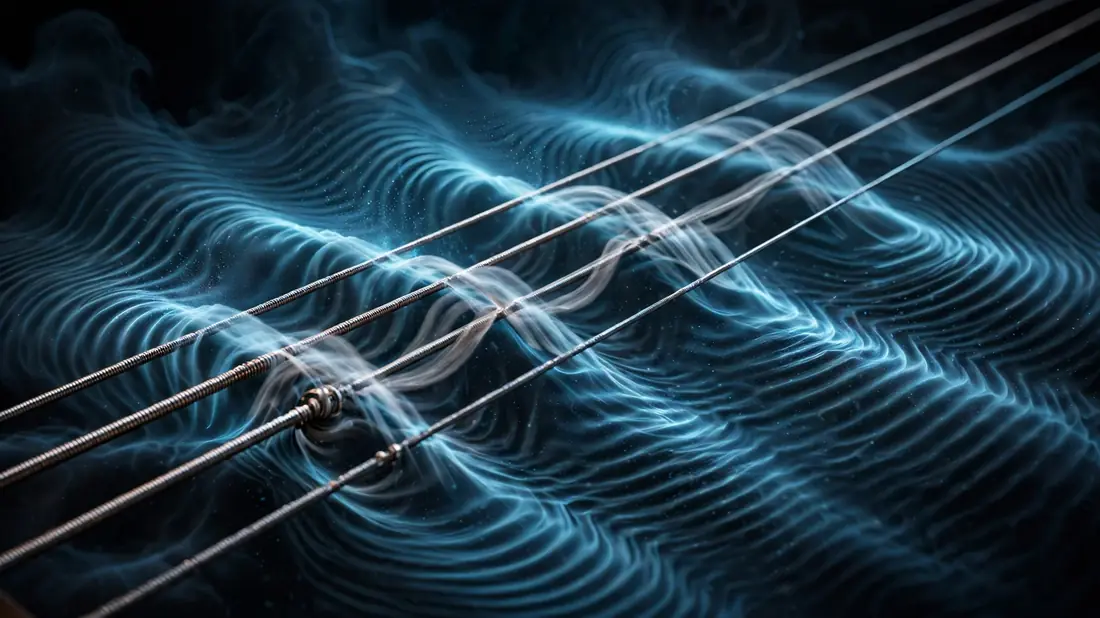
With the music question settled, the episode returns to the original prophecy: earth sinking, stones raining, faces changing. The natural question is whether music has any direct connection with such phenomena. On the surface, the link is invisible. But consider what music physically is: vibrations and oscillations — a plucked guitar string vibrates rapidly, and that vibration is what the ear hears as sound. Now remember the scale: thousands of concerts running at this very moment around the world, an ocean of musical vibrations pouring into the earth's air and ground. Loud sounds and continuous vibrations create microscopic movements in the earth's crust, and geophysics experiments have shown that continuous vibrations make loose soil particles shift — the first stage of subsidence. The episode presents this as a possible mechanism for khasf: the earth's field disturbed by such vibrations, the disturbance surfacing as the ground sinking. This must be stated plainly — it is the episode's speculation, not a prophetic statement. The hadith gives the conditions; it gives no mechanism. But the idea is worth noting for one reason: it shows how seriously the tradition takes the physical world, which the Quran describes as aware and responsive, not as dead matter.
Why This Is a Sign, Not a Ban List
It is easy to read all of this as a list of prohibitions and miss the point. The end-times narrations are not music reviews. They are describing a society — one in which entertainment is everywhere, instruments are ordinary, and the idea that any of it could be a problem sounds strange to people's ears. That is what makes it a sign. The narration in Sahih al-Bukhari about the four things (5590) makes the same point from the other side: the sign is not that people commit sins — they have done that in every age — but that they stop being able to name them as sins. When the prohibition itself becomes the surprising thing, the description has arrived. Read this way, the music question is less about a playlist and more about a worldview: what a society celebrates, what it normalises, and what it has forgotten how to question.
A Practical Path
So what does a reader do with all of this? The texts do not ask anyone to become a scholar of acoustics. They ask for something simpler: guard what enters the heart. If the music question troubles you, start with limits — less of it, none of what degrades you, and more of the Quran's recitation in its place. Protect the hours: the prayer, the remembrance, the silence that lets a person hear his own thoughts. And keep the one firm rule of this whole subject: never set a date for the Hour. "Indeed, Allah [alone] has knowledge of the Hour" (Surah Luqman 31:34). The signs are given to change conduct, not to feed curiosity. The person who takes that seriously has understood the narrations better than the one who memorises every detail and changes nothing.
✅ Guide4U Islam Checklist
- Read Luqman 31:6 and Isra 17:64 in translation
- Learn the daf narration: Bukhari 952
- Know the vow boundary: Tirmidhi 3690
- Recall Bukhari 5590: instruments among the four things
- Watch for lahw: pleasure that numbs the heart
- Replace idle sound with Quran and silence
- Set no dates for the Hour
Key Takeaways
- The Quranic standard for music is its effect: does it distract from remembrance or lead to sin (Luqman 31:6)?
- The narrations place instruments among the end-time markers (Tirmidhi 2212, Bukhari 5590) — the daf excepted within limits.
- Speculation about mechanisms is not prophetic fact; the signs are for conduct, not curiosity.
Frequently Asked Questions
Is all music haram in Islam?
This guide does not issue a ruling, and neither should an article. It presents the evidence the episode's research gathered: the Quranic verses (Luqman 31:6, Al-Isra 17:64), the Companions' interpretation, the prophetic warnings, the daf exception (Bukhari 952), and the scientific observations. Scholars have discussed the details at length, and readers with personal questions should ask a qualified scholar they trust.
What makes the daf different from other instruments?
The classical distinction is that the daf produces rhythm, not melody — a beat within natural limits, like a heartbeat, rather than the harmonic structures the tradition associates with intoxication of the senses. The narrations permit it within limits: at celebrations like Eid (Bukhari 952), and to fulfil a vow (Tirmidhi 3690).
Is listening to music itself a sign of the Hour?
The narrations name the widespread prevalence of musical instruments as one of the conditions attached to the end-time punishments (Tirmidhi 2212), and Bukhari 5590 places instruments among the four things people will declare permissible. But a visible condition is not a date — the knowledge of the Hour belongs to Allah alone (Quran 31:34).
Can music really make the earth sink or change faces?
The hadith states the punishments and their conditions; it does not explain a mechanism. The vibration theory in this guide is the episode's speculation and must be read that way. What the believer affirms is the narrations' words themselves — that these things will come to pass — not any theory about how.