
Three Signs in One Narration: Mosques as Passageways, Sudden Death, and the Swollen Moon
Quick Answer
One narration from Anas ibn Malik brings together three signs of the Hour: mosques used as passageways, the prevalence of sudden death, and a moon that appears swollen beyond its phase. This article walks through each sign in plain language, notes where the sources and the science stand, and shows how all three sketch the same picture of heedlessness.
Three Signs, One Narration
End-times narrations sometimes bundle several signs into a single report, and one such narration from Anas ibn Malik describes three changes that will appear before the Hour: mosques treated as passageways, the spread of sudden death, and a moon that seems swollen beyond its phase. Each of these points to a world where attention is scattered and remembrance is thin. This article looks at all three in plain language, separating what the narration says from what scholars have discussed about it, and from what modern observation adds. Nothing here sets a date or claims the Hour is near; the purpose is understanding, not alarm. The approach is simple: read the narration carefully, note where the sources stand, then ask what each sign looks like in the world we know. Taken together, the three signs paint one picture of heedlessness - people too busy, too distracted, or too hurried to notice what matters.
The Narration: Mosques Used as Passageways
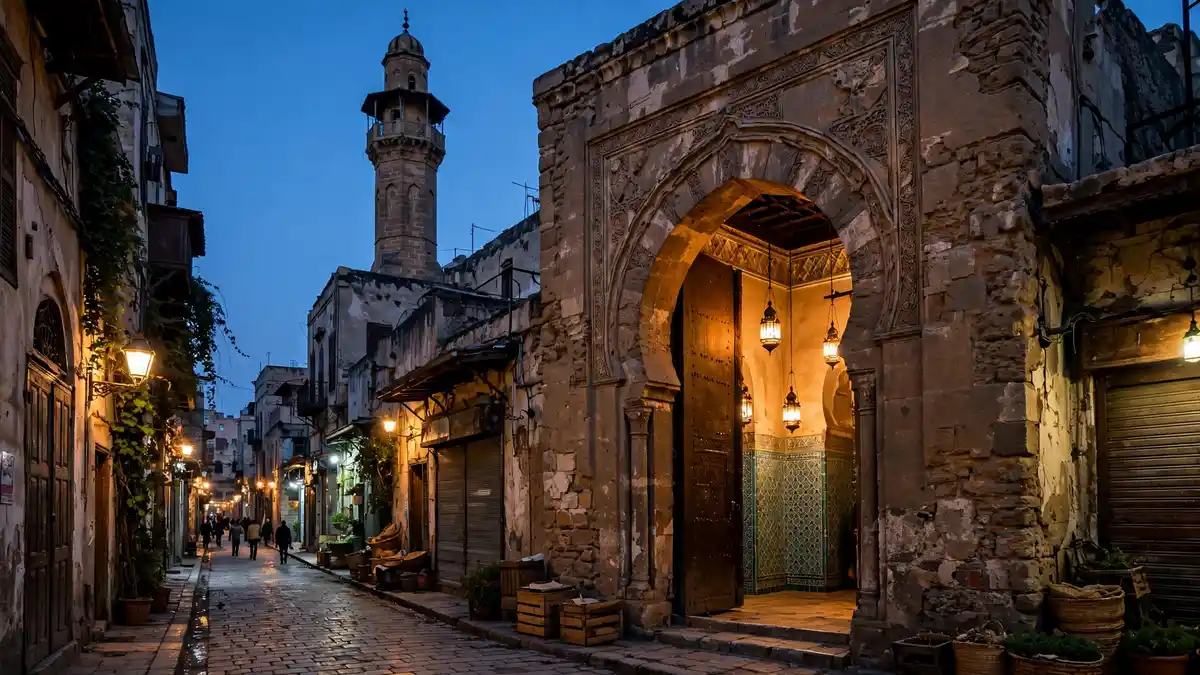
The first sign comes through a narration attributed to Anas ibn Malik, one of the Prophet's closest companions. In it, the Prophet ﷺ is reported to have said that among the signs of the Hour is that men will pass through a mosque without praying in it - that is, they will cut across the prayer hall as though it were a shortcut. The citation given for this report is al-Mu'jam al-Awsat of al-Tabarani, hadith 9376. Readers should know one thing plainly: this collection is not hosted on well-known public hadith databases such as sunnah.com, so the citation cannot be cross-checked through the usual online route. We state the reference exactly as it is given and attach no authenticity grade to it, since that judgment belongs to qualified hadith scholars, not to this article. What matters for the discussion is the image itself: a sacred space reduced to a corridor.
Market Mosques and the Shortcut Habit
The narration's image is easy to picture once you consider where mosques stood in the Prophet's city: near markets, crossroads, and busy lanes. A mosque that sits on a shortcut route invites hurried feet, and the sign describes a time when that temptation wins - people step through the door to save a few minutes, never stopping to pray. Scholars discussing this narration have read it as a symptom of shrinking reverence: the mosque stops being a destination and becomes a convenience. The building is open, the prayer mat is near, and yet the moment passes unused. What is striking is the ordinariness of it. No dramatic event is described, only a quiet habit repeated by enough people that it becomes a sign of the age. The modern parallel needs no explanation: anyone who has watched crowds stream past an open door while heading somewhere else has seen the posture this narration sketches.
- The mosque is entered but never prayed in
- The shortcut is chosen over the prayer
- Reverence quietly gives way to routine
The Second Sign: Sudden Death
The second sign in the narration is the spread of sudden death - people taken in an instant, with no illness to warn them and no time to prepare. Older generations feared long declines; this sign points to the opposite: a life cut off mid-stride. It is a theme the early sources return to more than once, and it has a plain modern echo. Death that arrives without warning leaves families stunned and communities uneasy, because it breaks the quiet assumption that we will get a signal first. The narration treats this as a marker of the last age: not that people die, which has always been true, but that unexpected, abrupt death becomes common enough to define the atmosphere of the time. Readers in any century can recognize the feeling, but the medical facts of our own era give the sign a sharper outline.
Heart and Vessel Disease: The Leading Killer
Modern medicine gives the sign a concrete anchor. The World Health Organization identifies cardiovascular diseases as the world's leading cause of death, accounting for about 17.9 million deaths per year in its 2024 reporting. Heart and vessel disease is, in plain terms, the world's leading killer - and a large share of those deaths are heart attacks, which can strike with little or no warning. This does not 'prove' the narration in any scholarly sense, but it shows the sign is describing something real and measurable in our time. A few facts frame the picture: heart attacks are the most abrupt face of heart disease; many victims had no prior diagnosis; and the disease burden falls on rich and poor countries alike, though patterns differ. The narration spoke of sudden death as a sign; today's statistics describe sudden cardiac death as a routine entry in the world's mortality ledgers.
- Heart attacks often strike with little or no warning
- Many victims had no prior diagnosis
- The burden reaches rich and poor countries alike
Striking the Young: A Careful Note
One claim circulating in the episode's research deserves a careful note. A figure of a 22% increase in heart attacks among people aged 15 to 25 is cited in the research materials, but it is flagged there as not independently verified - and we repeat it here only in that form, as a figure cited in the research, not as an established fact. What can be said with confidence is the broader pattern: physicians in many countries report seeing heart events in younger patients more often than in the past, and lifestyle explanations are the context - long hours of sitting, processed food, stress, poor sleep, and the pressures of work. The industrial era reshaped how bodies live: manual days gave way to desk days, and diets built around fresh cooking gave way to diets built around speed. None of this was said in seventh-century Arabia, but the narration's image of people dropping suddenly fits an age of strained hearts.
Ibn Sina and the Heart's Pain
The medical side of this sign has deep roots in Islamic scholarship itself. Ibn Sina, the eleventh-century physician and philosopher, devoted careful attention to the heart in his great medical work Al-Qanun (The Canon of Medicine), describing pains and disorders of the heart in terms his students could recognize and treat. The episode's research highlights this as a reminder that heart disease is not a new invention of the modern world - learned physicians were studying the heart's failures a thousand years ago. What has changed is the scale and the speed of life around those failures. In Ibn Sina's age, heart pain was a physician's case; in ours, sudden cardiac events are a public statistic. The contrast sharpens the sign: the organ is the same, but the age around it has grown faster, heavier, and more hurried, and the narration's warning about sudden death reads less like a distant prophecy than a description of the morning news.
The Third Sign: The Swollen Moon
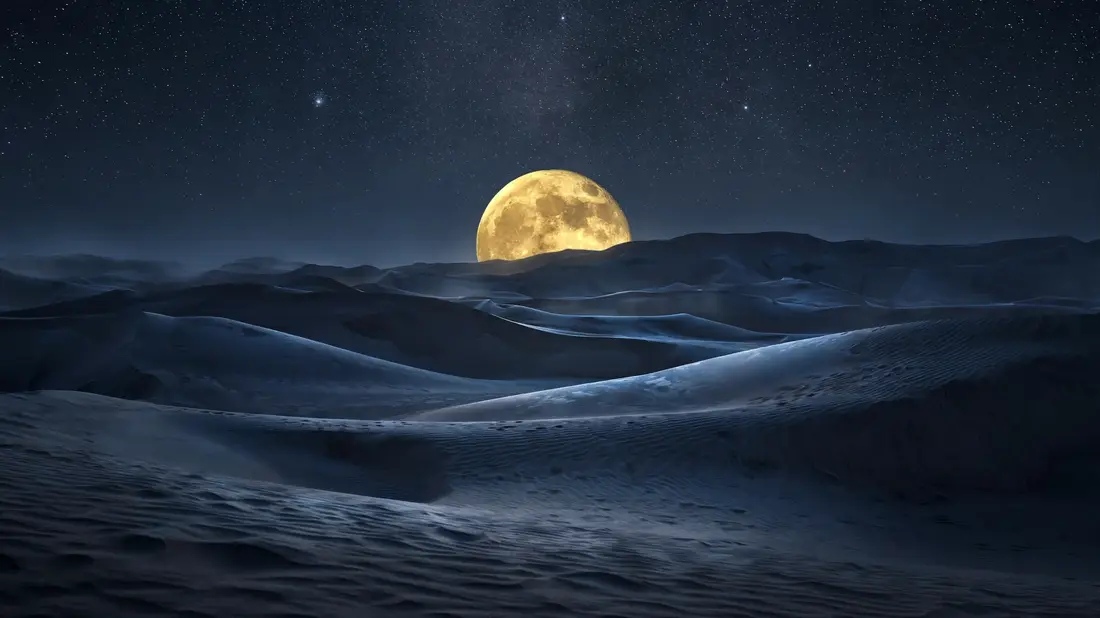
The third sign is the strangest of the three: the moon appearing swollen, inflated beyond what its phase should show. Anyone who watches the night sky has had the experience of the moon looking larger than expected - rising huge and low over the horizon, filling more of the sky than it seems it should. The narration presents this as a sign of the last age: a familiar body behaving, to the eye, in an unfamiliar way. Unlike the first two signs, this one has no obvious social cause; it is a sign written in the sky rather than in human conduct. That is part of its power. Mosques and heart attacks belong to the world of human choices, but the moon belongs to everyone and no one. When the narration lists it alongside the other two, it suggests that the heedlessness of the age reaches beyond human behavior into the very texture of what people see above them.
How the Episode Explains the Swollen Moon
Here the episode offers its own explanation, and we present it strictly as the episode's view, not as settled science. The suggestion is that the swollen appearance of the moon comes from the way light bends and scatters as it passes through the lower atmosphere - the same layer where dust, moisture, and haze gather. When the moon sits low, its light travels through more of this layer, and the scattering can make its disc look larger and sometimes tinted. The episode treats this as an atmospheric effect tied to changing skies: more haze, more scattering, a moon that looks inflated to watchers on the ground. Whether or not that account holds up under expert review is beyond this article's scope; what matters is that the explanation is offered as interpretation, and the narration's core claim - that the moon will look swollen - stands on its own as the sign. The sky, in this reading, mirrors the age.
- Offered strictly as the episode's view, not settled science
- Light bends and scatters through the lower atmosphere
- More haze means more scattering, so the disc looks larger
One Picture: Heedlessness
Read together, the three signs tell a single story about heedlessness. The man who crosses the mosque without praying is too busy to stop. The community where sudden death is common has grown used to bodies giving out under the strain of hurried lives. The watchers who see a swollen moon look up only long enough to notice something odd, then look away. Each sign is a picture of attention failing: the sacred treated as a shortcut, the body treated as a machine, the sky treated as background. That is why the narration groups them. They are not three random predictions but three angles on one condition - people too busy, too distracted, or too heedless to notice what is in front of them. The value of such signs is not in forecasting dates, which no narration permits, but in the quiet question they leave behind: what are we walking past today?
- The sacred treated as a shortcut
- The body treated as a machine
- The sky treated as background
✅ Guide4U Islam Checklist
- Pray when you enter a mosque, even two short rak'ahs
- Take heart health seriously: move daily, sleep well
- Do not ignore chest pain; seek care promptly
- Look up at the night sky and reflect
- Slow down; heedlessness is the common thread
- Verify hadith citations through qualified scholars
Key Takeaways
- The Tabarani 9376 citation is reported exactly as given; with no sunnah.com copy available, no authenticity grade is attached here.
- Heart and vessel disease is the world's leading killer at about 17.9 million deaths a year, giving the sudden-death sign a measurable modern anchor.
- All three signs describe one condition: people too busy, too distracted, or too heedless to notice what is in front of them.
Frequently Asked Questions
Is the Tabarani narration about mosques as passageways authentic?
The citation is given as al-Mu'jam al-Awsat of al-Tabarani, hadith 9376, but this collection is not available on sunnah.com, so the report cannot be checked through the usual online sources. We attach no authenticity grade here; that judgment belongs to qualified hadith scholars. The article discusses the sign's meaning, not its grading.
Does the article claim heart attacks are increasing among the young?
No. A figure of a 22% increase among 15- to 25-year-olds appears in the episode's research, but it is flagged there as not independently verified, and we present it only in that form. What is established is the WHO figure: cardiovascular diseases cause about 17.9 million deaths per year, making heart and vessel disease the world's leading killer.
What causes the swollen moon?
The episode offers its own explanation: light bending and scattering as moonlight passes through the lower atmosphere, where dust, moisture, and haze gather, can make the moon's disc look larger and sometimes tinted. We present this strictly as the episode's interpretation, not as settled science; the narration's claim that the moon will appear swollen stands as the sign itself.
Do these signs tell us when the Hour will come?
No. No narration permits date-setting, and this article sets none. The signs are discussed as descriptions of heedlessness - people too busy, too distracted, or too hurried to notice - meant for reflection, not for forecasting.