
Trials, Lying and the Coming Together of Markets: One Narration, Three Signs of the Hour
Quick Answer
One narration cited by the episode from al-Haythami's Majma al-Zawaid (7/330), traced to Musnad Ahmad, mentions three signs together: trials will spread, lying will spread, and markets will converge and merge into one. This article examines each sign and traces the long road from the souqs of the Prophet's Arabia to the single connected market of the internet age.
One Narration, Three Signs
Some narrations of the end times bundle several signs into a single report. One such narration, which the episode cites from al-Haythami's Majma al-Zawaid (7/330), traced to Musnad Ahmad, mentions three things together: that trials will spread, that lying will spread, and that markets will converge and merge into one. We attribute the narration exactly as the episode gives it and make no claim about its authenticity grade, since the episode does not grade it. What matters for this article is the picture the three signs paint when they are read together: a world of spreading confusion, spreading falsehood, and a single merged marketplace. The rest of this article walks through each of the three, and then traces the long road from the markets of the Prophet's Arabia to the world market of our own time.
Trials Will Spread
The first of the three is the spread of trials, the fitan that the Prophet warned would fall upon the community like pieces of a dark night. Trials here mean more than personal hardship: they mean public confusion, when truth and falsehood become hard to tell apart and people are pulled in many directions at once. The narration says these trials will spread, which suggests not isolated incidents but a general condition, something in the air of the age. Readers of every generation have found this description familiar, because every age has its own storms. The sign does not name a single event; it describes a climate, and it asks the believer to hold fast to what is clear when much around them grows unclear.
Lying Will Spread
The second sign is the spread of lying. The Prophet warned in authentic narrations that truthfulness leads to righteousness and lying leads to wickedness, and here the narration says falsehood will become widespread. This is not only about individuals telling lies; it is about lying becoming normal in public life, in trade, in politics, and in the stories people tell about one another. When lying spreads, trust breaks down, and a community that cannot trust what it hears cannot make sound decisions. The pairing with trials is telling: confusion grows where truth is scarce. Together the two signs describe a world in which falsehood is both widespread and unrecognised, a darkness that feeds on itself.
Markets Will Converge Into One
The third sign is the one this article follows the longest: markets will converge and merge into one. In the Prophet's time, markets were local and separate, each town with its own souq, its own traders, its own prices. The narration foretells a time when these separate markets draw together until they function as one. For fourteen centuries this must have sounded strange. Markets were divided by deserts, seas, mountains, and months of travel. Yet the centuries that followed have carried trade step by step toward exactly this picture. The rest of this article traces that road: from the souqs of Arabia, along the Silk Road, through the age of companies and industry, to the global institutions and the internet that have made one connected market a daily reality.
The Markets of the Prophet's World
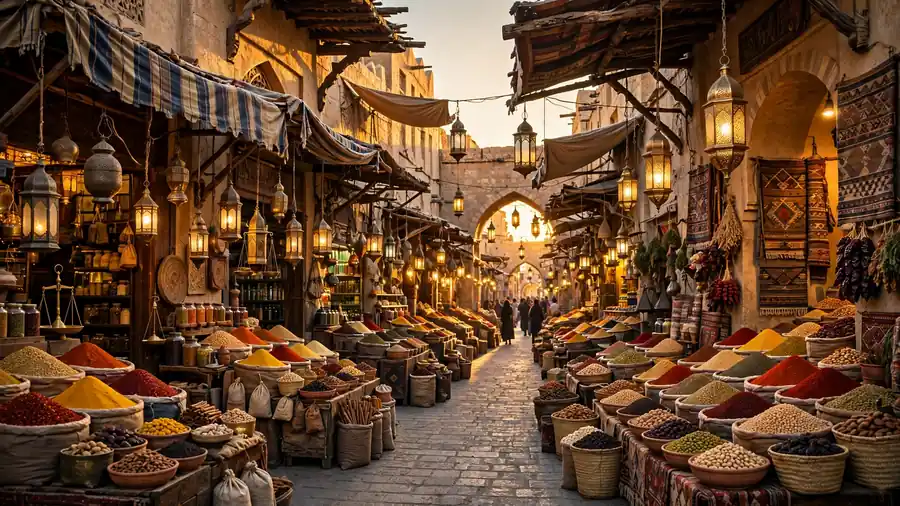
The markets the Prophet knew were seasonal and tribal. Near Mecca, the great fairs of Souq Okaz, Majana, and Dhul-Majaz drew tribes from across Arabia for trade, poetry, and the settling of disputes. In Medina, the Jewish tribe of Banu Qaynuqa ran a well-known market. The Prophet himself established a market in Medina and declared it tax-free, a place where any trader could come and sell without paying dues to a chief. These were separate worlds: the fair at Okaz did not set prices in Medina, and the caravan that left Yemen in winter had no notion of the markets of Persia. Each market lived its own life, and the idea that they would one day merge into a single market would have been beyond imagination.
The Silk Road and the First World Trade
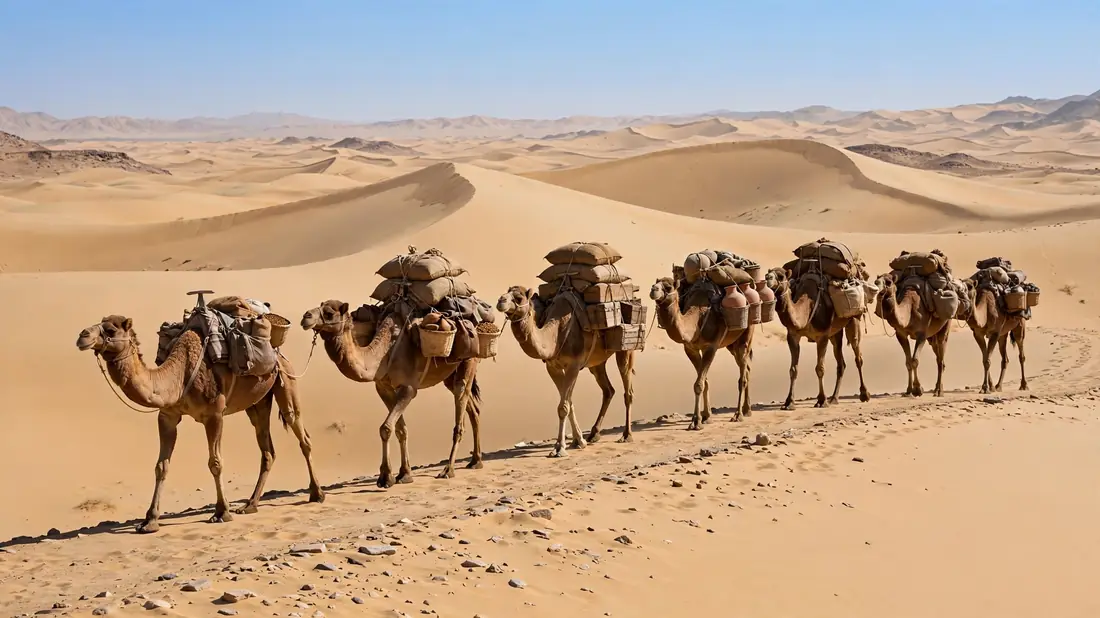
Long before the modern age, the Silk Road began joining distant markets into longer chains. Caravans carried silk from China, spices from India, glass from the Mediterranean, and horses from the steppe, passing goods from hand to hand across thousands of miles. No single trader travelled the whole road; each link in the chain bought from one neighbour and sold to the next. Prices in one city slowly began to affect prices in another, and news of a harvest or a war travelled with the camels. It was not one market yet, but it was the first sketch of one: a web of trade in which distant peoples, who would never meet, depended on one another's goods.
Companies, Empires, and Industry
The next great step came with the trading companies of the early modern age, such as the East India companies of Britain and the Netherlands. These were not simple caravans but large organisations with ships, forts, armies, and the backing of states. They joined the markets of Europe, Asia, and the Americas into single trading systems run from distant capitals. Then came the Industrial Revolution, which filled those systems with factory-made goods and cut the cost of moving them by rail and steamship. Prices began to move together across continents: a bad harvest in one land raised bread prices in another. The markets were still many, but the walls between them were getting thinner every decade.
One World Market: Banks, Funds, and Trade Rules
After the Second World War, nations built institutions to manage trade on a global scale: the World Bank, the International Monetary Fund, and later the World Trade Organization. These bodies set common rules for how goods, money, and investment move between countries. Tariffs fell, currencies became convertible, and a factory in one country could sell in a hundred others under the same set of rules. Money markets merged first, with currency prices flashing on screens in every financial capital at once, and goods markets followed. The separate souqs of the old world had become departments of a single system. A merchant in Karachi and a merchant in Kuala Lumpur now check the same prices, borrow under the same rules, and sell to the same distant buyers.
The Internet Puts a Market in Every Pocket
Then came the change the narration's words seem to point at most directly: the internet, and with it online shopping. A buyer no longer needs to visit any physical market; the market comes to the phone in their pocket. A seller in one country lists a product in the morning, and a buyer on another continent orders it by night. Prices are compared across the whole world in seconds, and small traders compete with great companies on the same screen. The mobile phone has become a marketplace in itself: browsing, bargaining through messages, paying, and tracking delivery all happen in one device. The separate markets of the old world have not just converged; for the ordinary buyer, they have become one market with one window.
Advertising Money and the 5G Question
Our episode adds two further points, and both need careful handling. First, it notes the enormous sums spent on advertising each year, putting the figure at around 800 billion dollars, and treats this flood of promotion as part of the merged market: sellers competing for the attention of one global crowd of buyers. We repeat the figure only as the episode's own estimate, not as a verified fact. Second, the episode connects the convergence of markets to fifth-generation wireless networks as its own speculation, suggesting that faster connections will tighten the merger further. This is the episode's view, not the narration's, and it should be read that way. The narration itself says only that markets will converge and merge into one; everything beyond that is commentary.

The Hague Starlings and an Honest Limit
The episode also mentions the October 2018 incident in The Hague, where hundreds of dead starlings fell in a park, and some voices online blamed a 5G test. Here the episode is careful, and we must be careful too: the episode itself reports that the authorities denied any link to 5G and that fact-checkers debunked the claim. We state that plainly and draw no conclusion from the incident. It is included only to show how easily fear and speculation attach themselves to new technology, which is itself part of the climate the first two signs describe. The honest limit of this article is the narration's own words: trials will spread, lying will spread, and markets will converge and merge into one. On those three points the modern world offers much to reflect on; beyond them, we do not go.
✅ Guide4U Islam Checklist
- Note the narration's source as the episode gives it
- Claim no authenticity grade for the narration
- Read the three signs as one picture
- Recall the Prophet's tax-free market in Medina
- Trace trade from the Silk Road to the internet
- Treat the ad figure as the episode's estimate
- Draw no conclusion from the Hague incident
Key Takeaways
- The episode cites one narration mentioning trials, lying, and merged markets together.
- Trade has moved from separate souqs toward one connected world market.
- Speculation stays labeled; the narration's words set the honest limit.
Frequently Asked Questions
Where does the narration about trials, lying, and markets come from?
The episode cites it from al-Haythami's Majma al-Zawaid (7/330), traced to Musnad Ahmad. The episode does not give it an authenticity grade, and neither do we. It is presented here as the episode's material, with its attribution exactly as the episode gives it.
What does 'markets will converge and merge into one' mean?
In the Prophet's time markets were local and separate, each with its own traders and prices. The narration foretells a time when separate markets draw together until they function as one. The article traces how trade moved from the souqs of Arabia through the Silk Road, the age of companies, global institutions, and the internet toward a single connected market.
Is the 800 billion dollar advertising figure a fact?
No. The episode puts the figure at around 800 billion dollars a year, and we repeat it only as the episode's own estimate. It is used to illustrate the scale of competition for buyers' attention in the merged market, not as a verified statistic.
Did 5G kill the starlings in The Hague in 2018?
The episode itself says no link was established: authorities denied any connection to 5G and fact-checkers debunked the claim. The incident is mentioned only to show how quickly speculation attaches to new technology, and we draw no conclusion from it.