
What Was Inside the Ark of the Covenant? The Five Relics, Explained

Quick Answer
The commentaries agree on five relics inside the Ark of the Covenant: the tablets of Moses, the staff of Moses, the staff of Aaron, a vessel of manna, and Sakina itself. The Quran's verses on each are quoted from a verified translation, while the episode's additional reports - the three things, the tablets' materials, the almond staff, the manna's taste - are presented with their source caveats stated openly, including a correction to the episode's attribution of Bukhari 5011.
Five Items, and Every Commentary Agrees
The last article of this series asked what the Ark of the Covenant is. Now the harder question: what was inside it? The episode reports that the commentaries - across the traditions that discuss the Ark - agree on five relics kept within the chest: the tablets given to Moses on Mount Sinai, the staff of Moses, the staff of his brother Aaron, a vessel containing manna, and Sakina itself - the divine tranquility named in Surah Al-Baqarah 2:248 that gave the whole chest its second name. Two further items appear in some commentaries but not all: the shirt of Prophet Joseph, and a paradisiacal substance called Ranjmine. Each of the five has its own verses and its own history, and each is examined here with the sources handled exactly as the episode presents them.
The Chest Itself
Before the relics, the chest. The episode reports the commentaries' account: a box about four feet long and two and a half feet wide and high, made of acacia wood - shisham, boxwood - a timber the Israelites prized for its weight, its resistance to insects, and the fine carvings its grain allowed. From the Torah's accounts, the episode adds, the wooden chest sat inside a casing of gold bearing images of angels' wings, and it was kept in a separate tent wherever the Israelites camped - the 'House of Holies' - until Solomon's Temple gave it a permanent room at its center, the Holy of Holies. The Levites, the tribe of Moses and Aaron, were its keepers, covering it with fine blue cloth. All of this is the episode's account of the commentaries, reported as such.
The Tablets of Moses: The First Relic
The first and greatest relic was the set of tablets given to Moses on Mount Sinai. The Quran says of them: 'And We wrote for him on the tablets [something] of all things - instruction and explanation for all things, [saying], "Take them with determination and order your people to take the best of it. I will show you the home of the defiantly disobedient."' (Quran 7:145, Saheeh International). The episode dwells on the weight of this: writing that a tradition 'found in the section of Ibn Jarir' says only three things were ever touched by Allah's hand, as befits His majesty - the plantings of Paradise, the creation named in Surah Sad, and these tablets. The episode gives no collection for that tradition, and we report it with that caveat stated plainly.
The Tablets Are Not the Torah
Here the classical commentators make a careful distinction, and the episode follows them: the tablets were not the Torah itself. The Quran speaks of the tablets in Al-A'raf 7:145, of Moses setting the tablets down when he saw the calf in 7:150 - but in Al-An'am 6:154 it speaks of a book given to Moses. From the different wordings, the commentators conclude the tablets carried the core principles - the commandments, the 'do and do not' - while the Torah was the complete revealed law. The episode adds an astonishing detail from the Tabi'i Rabi ibn Anas: that the full Torah took at least a year to read, and only four people ever read the first revealed Torah completely - Moses, Joshua, Uzair, and Jesus. As always, the episode gives no collection for this; it is reported as the episode states it.
What Were the Tablets Made Of
Even the tablets' material is debated, and the episode collects the opinions. Some early scholars, like Imam al-Kalbi, said emerald. The Tabi'in Saeed bin Jubair, Ibn Jurayj, and Wahb bin Munabbih said ruby - deep red ruby. Others said stone. The episode's own reasoning, labeled as its own, notes that the Quran speaks of tablets in the plural, so it is possible some were emerald, some ruby, and the rest stone. It adds two more details from the tafsir tradition: that the sound of the writing on the tablets was audible to Moses on Sinai, and that Wahb bin Munabbih described the script as raised, embossed writing, like thumb imprints. Both are the episode's reports, given without collections - stated openly, never dressed up as verified hadith.
The Staff of Moses: The Second Relic
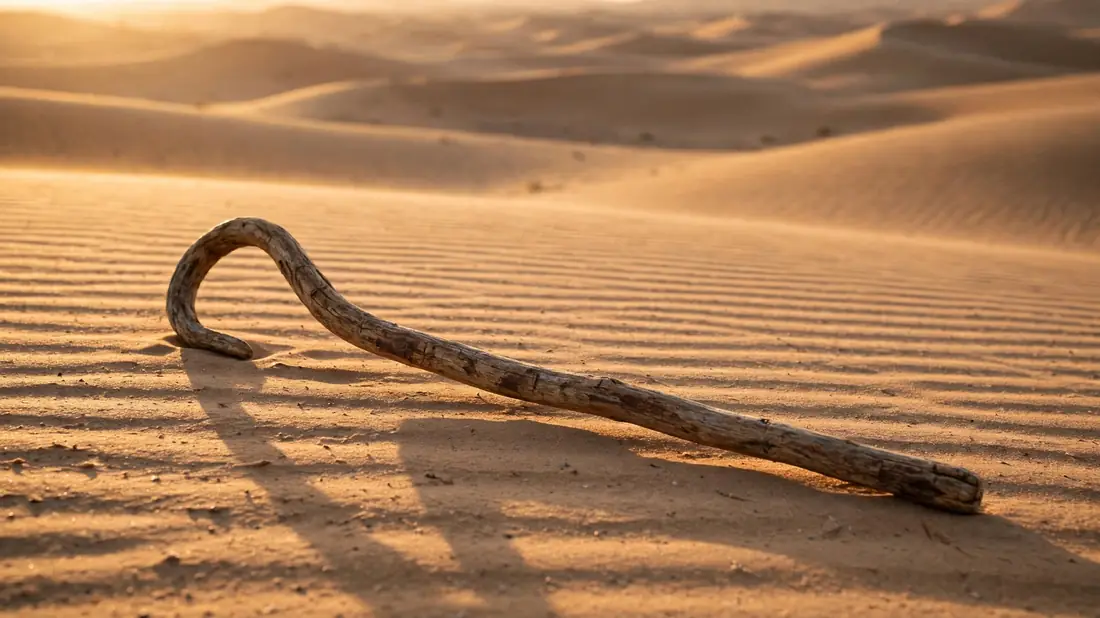
The second relic was the staff of Moses, and the Quran introduces it in the first conversation between Allah and Moses: 'And what is that in your right hand, O Moses?' He said, 'It is my staff; I lean upon it, and I bring down leaves for my sheep and I have therein other uses.' [Allah] said, 'Throw it down, O Moses.' So he threw it down, and thereupon it was a snake, moving swiftly. [Allah] said, 'Seize it and fear not; We will return it to its former condition.' (Quran 20:17-21, Saheeh International). What began as an ordinary shepherd's staff became one of the great signs of prophethood. The episode asks why a serpent at all - and answers from Egypt's own symbols: the snake on Pharaoh's crown was the emblem of ultimate power, so the staff's transformation spoke to Pharaoh in his own language: that power now belonged to Allah.
One Serpent, Three Words
Here the Quran does something remarkable, and the episode draws it out. The serpent is not named with one word but three. In Ta-Ha 20:20 it is hayyah - a living snake. In Al-A'raf 7:107 and Ash-Shu'ara 26:32 it is thu'ban mubeen: 'So [Moses] threw his staff, and suddenly it was a serpent manifest' (Saheeh International) - a great, powerful constrictor. In An-Naml 27:10 and Al-Qasas 28:31 it is jann - the Quran describes it writhing swiftly, a quick, darting serpent. The episode's reasoning - labeled as its own - is that the staff did not become merely one snake but took different serpent forms for different moments: the swift one at the first encounter, the manifest constrictor before Pharaoh's court. The words are the Quran's; the reading is the episode's.
The Sea and the Rock
Two more miracles of the staff are named in the Quran, and the episode treats both as its proofs against those who would explain miracles away. When the sea blocked the Israelites' escape, the command came: 'Then We inspired to Moses, "Strike with your staff the sea," and it parted, and each portion was like a great towering mountain.' (Quran 26:63, Saheeh International). The episode notes the verse's wording defeats the old tide-theory: each part stood like a mountain, not a receding shoreline. And in the desert, when the people asked for water: 'And [recall] when Moses prayed for water for his people, so We said, "Strike with your staff the stone." And there gushed forth from it twelve springs, and every people knew its watering place.' (Quran 2:60, Saheeh International) - one spring for each of the twelve tribes.

Aaron's Staff: The Third Relic
The third relic belonged to Aaron, the brother of Moses - and its story comes from the Bible, which we state clearly. The episode reports that after Moses' death, the eleven other tribes questioned why the Levites alone should guard the Ark, so the leaders' staffs were laid together and the one that changed would decide the matter. From the Book of Numbers, the episode recounts: Aaron's staff blossomed - leaves, buds, flowers, and almonds appeared on it overnight. The episode adds the Hebrew tradition's reading of the almond: the first tree to bloom in the season, a sign that Aaron's tribe should be given the duty promptly. This entire account is the Bible's, reported through the episode - not a hadith, and never presented as one.
The Vessel of Manna: The Fourth Relic
The fourth item was a vessel holding manna, the heavenly provision of the desert years. The Quran names it among Allah's blessings on the Israelites: 'And We shaded you with clouds and sent down to you manna and quails, [saying], "Eat from the good things with which We have provided you." And they wronged Us not - but they were [only] wronging themselves.' (Quran 2:57, Saheeh International). The episode describes manna, on the report of the Tabi'i Rabi ibn Anas, as a dew-like substance descending at dawn, whiter than milk and - in his words - ninety times more delicious than today's honey; and salwa as a quail-like bird brought down by a red wind in the thousands. The episode gives no collection for the Rabi ibn Anas description, and we report it with that caveat, as always.
Sakina Itself: The Fifth Relic
And now the fifth relic - which the episode says very few people discuss: Sakina itself, the living presence named in 2:248. Here a correction is owed. The episode attributes the famous Sakina narration to the Companion Usaid ibn Hudayr reciting Surah Al-Kahf - but the verified text of Sahih al-Bukhari 5011 comes from Al-Bara' ibn Azib about an unnamed man: 'A man was reciting Surat Al-Kahf and his horse was tied with two ropes beside him. A cloud came down and spread over that man... The Prophet said, "That was As-Sakina (tranquility) which descended because of (the recitation of) the Qur'an."' The Usaid narration is a separate hadith, Bukhari 5018. The episode's other Sakina reports - Ali's narration via Khalid ibn Argara of a wind guiding Ibrahim at the Kaaba, Ibn Abbas on its two light-emitting eyes, Wahb ibn Munabbih on its speech - carry no collections, and we report them as the episode's account.
The Extras: Joseph's Shirt and Ranjmine
Beyond the five, the episode names two further reported contents. The first is the shirt of Prophet Joseph - the shirt he sent to his father Jacob, whose sight was restored when it was cast over his face. The Quran records Joseph's own instruction: 'Take this, my shirt, and cast it over the face of my father; he will become seeing. And bring me your family, all together.' (Quran 12:93, Saheeh International). The second is a paradisiacal substance called Ranjmine - a type of sugar, the episode says, with which the Israelites would break their fasts - but here the episode itself adds the caution: this is found in some commentaries, not in others. The five relics, by contrast, are found in every commentary. That is the line the episode draws, and this article draws it too.
✅ Guide4U Islam Checklist
- Five relics in every commentary: tablets, two staffs, manna, Sakina.
- Tablets = the commandments; the Torah was the separate book.
- 7:145: 'instruction and explanation for all things.'
- The staff: 20:17-21, 26:63, 2:60 - sea, rock, serpent.
- Sakina: Bukhari 5011 is Al-Bara's narration, not Usaid's.
- Joseph's shirt: Quran 12:93; Ranjmine only in some commentaries.
Key Takeaways
- The tablets carried the commandments; the Torah was the complete law revealed separately - the commentators' careful distinction.
- The staff's three serpent words - hayyah, thu'ban mubeen, jann - are the Quran's own; the episode's reading of them is labeled as such.
- Verified hadith stays verified: Bukhari 5011's Sakina narration belongs to Al-Bara's report, and the article corrects the episode's naming.
Frequently Asked Questions
What was inside the Ark of the Covenant?
The episode reports that every commentary names five items: the tablets given to Moses on Mount Sinai, the staff of Moses, the staff of his brother Aaron, a vessel containing manna, and Sakina - the divine tranquility named in 2:248. Two further items appear in some commentaries: the shirt of Joseph and a substance called Ranjmine.
Were the tablets the Torah itself?
No. The classical commentators conclude from the Quran's different wordings that the tablets carried the core principles - the commandments - while the Torah was the complete book of law revealed separately. The episode reports the Tabi'i Rabi ibn Anas as saying the full Torah took at least a year to read. That report is given without a collection, as the episode states it.
Why does the Quran use three different words for the serpent?
The Quran calls the staff's serpent by three words in different places: hayyah (a living snake, 20:20), thu'ban mubeen (a manifest serpent, 7:107 and 26:32), and jann (a swift, darting serpent, 27:10 and 28:31). The episode reads this as a sign the staff took different serpent forms for different moments - presented as the episode's reasoning, not the verses' wording.
What is Sakina - a feeling, or something more?
The episode reports narrations - without collections named - describing Sakina as a living presence with a face, conversing with the Israelites. What is verified is the authentic hadith: Sahih al-Bukhari 5011, in which the Prophet said of the cloud that descended over a reciter of the Quran, 'That was As-Sakina which descended because of the recitation of the Quran.' The rest is reported as the episode's account.